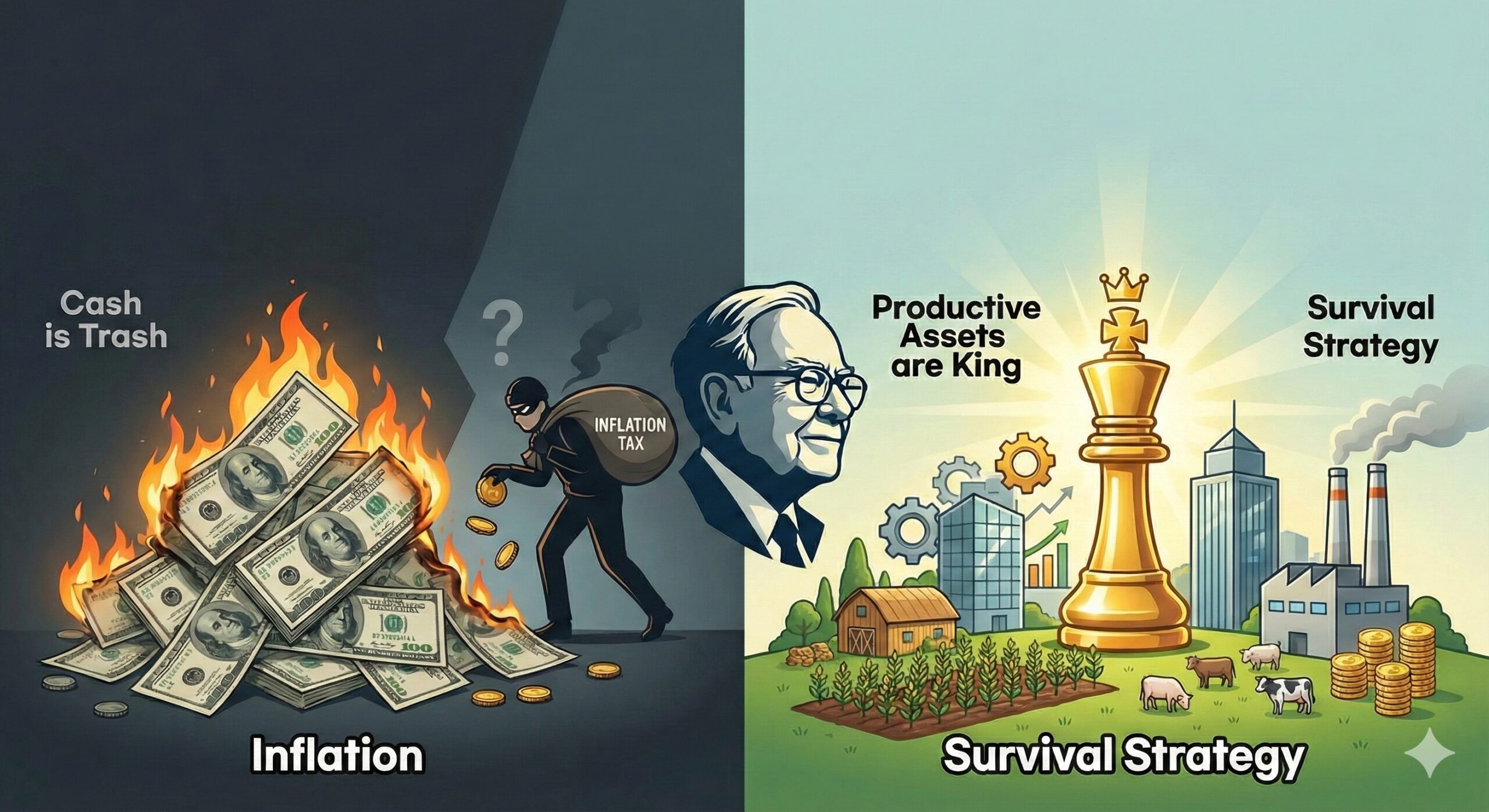
“Is Cash Trash or King?” Warren Buffett’s Guide to Capital Flow and Survival Strategies


Lan Briefing

Defining True Investment: The act of forgoing current consumption to secure greater purchasing power in the future.
The Silent Thief, Inflation: While basking in nominal returns, the “invisible tax” of inflation is quietly eroding your real wealth.
The Triumph of Productive Assets: Prioritize assets that generate value—such as farms, real estate, and businesses—over unproductive ones like gold or stagnant cash.


1. Started by the Wise, Finished by the Fool

There is an old adage in the investment world: “What the wise man does in the beginning, the fool does in the end.” This speaks to those who jump into the market only when it’s boiling over. Warren Buffett defines investing simply: it’s about skipping one hamburger today to enjoy two in the future.

However, many fall for the siren song of “instant” wealth and lose sight of this simplicity. Does a farm owner sell their land just because a fickle neighbor shouts, “Your farm’s value crashed today!”? Stocks are no different. They are not mere numbers on a chart; they are living, breathing businesses.


2. Interest Rates are Gravity: The Law of Capital Migration

Just as physics has gravity, the financial world has interest rates. When rates rise, the prices of all assets are pulled downward. The recent market turbulence is simply a manifestation of this law of gravity.

What we must focus on is capital efficiency. Buffett favors business models that create immense intangible value with minimal capital, rather than those requiring massive physical investment. It’s akin to high-yield real estate with low down payments. This structure—where your invested capital is small but the cash flow is significant—is the essence of capitalism and the “Path of Money” we should seek.


3. How to Smile in a Crisis: The 15% Buffer

By the time you hear “Cash is King,” it’s already too late. Paradoxically, the appeal of cash and bonds grows strongest when everyone else is calling cash “trash” and chasing the latest hype. Buffett consistently maintains a cash reserve of 10-15% of total assets.

This cash isn’t just sitting idle. it is high-powered ammunition to be deployed when fear permeates the market—specifically, when high-quality stocks become ridiculously cheap. Remember: in investing, fear is your friend, and euphoria is your enemy. The one who can shop calmly while others flee in panic is the one who laughs last.


📋 Lan-line Analyst’s Watch List (For Study)

Index Funds: Riding the Market’s Average Growth
* S&P 500 ETF (VOO, IVV): The most cost-effective way to enjoy the performance of America’s leading companies.

Productive Assets with Economic Moats: Superior ROIC
* Apple (AAPL): A brand-heavy model that generates massive cash flow with relatively low capital intensity.

Safety Net for Liquidity
* Short-term Treasury Bills: A tool to maintain 10-15% liquidity to seize opportunities during market drawdowns.


📊 Closing Thoughts

In the short run, the market is a voting machine—fickle and popularity-driven. In the long run, however, it is a weighing machine that accurately measures a company’s true substance. When terrifying news headlines flash, focus on the “easy” decisions. Buy great businesses, outpace the tax of inflation, and let time work its miracle. That is the most certain formula for victory that any of us can follow.

💡 Today’s Insight:

“When you treat the market as a servant rather than a master, you transition from a spectator to a true owner of wealth.”


📎 References

⚠️ Disclaimer
This content is for informational purposes only and should not be considered as investment advice. Investment decisions and their outcomes are solely the responsibility of the investor. The information provided may be inaccurate, and we do not guarantee its accuracy or profitability.

The Yen Post-Election: How Takaichinomics and the ‘Net Debt’ Pivot are Reshaping the Japanese Market


Lan Briefing

A Paradigm Shift in Fiscal Rules: The pivot from ‘Total Debt’ to a ‘Net Debt’ framework is a strategic masterstroke designed to pave the way for aggressive fiscal expansion.
The Nexus of Security and Growth: Increased defense spending and the push for energy sovereignty signal the return of a state-led “Growth First” doctrine in Japan.
Opportunity in the Policy Mismatch: We are entering a volatile yet lucrative transition where fiscal expansion clashes with monetary tightening (rate normalization). Smart capital is already positioning for this shift.


1. The Re-definition of Debt: A Sophisticated Play for Leverage

The core of the economic doctrine led by Prime Minister Takaichi lies in a fundamental “shift in perspective” regarding national debt. By moving away from the “Total Debt” narrative—which often fixates on Japan’s 250% debt-to-GDP ratio—the administration is shifting the goalposts to ‘Net Debt’ (Total Debt minus the government’s vast foreign reserves and assets).

This isn’t just a creative accounting trick. Think of it like a household that stops worrying about the mortgage principal and starts focusing on its massive savings and investment portfolio to justify taking on more leverage for growth. This shift effectively bypasses traditional fiscal constraints, providing the “green light” for massive capital injections into national defense and high-tech industries.

2. The Mechanics of Money: Expansionary Fiscal Meets Tightening Monetary

Contrary to initial market jitters about austerity, the essence of Takaichinomics is strategic expansion. Japan’s ambition to become a “normal state” with robust defense capabilities—evidenced by the deployment of F-35B stealth fighters—requires a surge in military spending, which in turn necessitates large-scale bond issuance.

For investors, the key lies in the policy mismatch. As the government pumps liquidity into the system to stimulate the economy and defense sectors, the Bank of Japan (BOJ) will be forced to accelerate interest rate hikes to defend the currency and manage inflation. We are witnessing a structural evolution where fiscal expansion paradoxically drives monetary normalization. The era of the “Yen Carry Trade” is fading, replaced by a domestic “Re-rating” of Japanese assets.

3. Investment Strategy: Policy Beneficiaries and Inflation Hedges

Warren Buffett’s massive bet on Japanese trading houses was a precursor to this “Strong Japan” scenario. As the government directs its budget toward energy, raw materials, and defense, these sectors will be the primary beneficiaries of state-led capital.

Simultaneously, the upward pressure on interest rates serves as a powerful catalyst for Japan’s “mega-banks,” whose Net Interest Margins (NIM) have been suppressed for decades. Investors must look past the surface-level volatility of the Yen and follow the “Fiscal Path” carved out by the new administration.

📋 Lan-line Analyst’s Watch List (For Study)

Defense & Infrastructure: Direct beneficiaries of fiscal expansion and defense budget hikes
* Mitsubishi Heavy Industries, Kawasaki Heavy Industries

Finance& Banking: Beneficiaries of monetary normalization and NIM expansion
* Mitsubishi UFJ Financial Group (MUFG)

General Trading Houses: Hedges for inflation and resource-driven growth
* Mitsubishi Corp., Itochu Corp.

📊 Closing Thoughts

Japan’s recent election was not merely a change in leadership; it was a declaration of intent to scale up the nation’s economic and military footprint by redefining the rules of its balance sheet. The keyword ‘Net Debt’ will serve as the most significant milestone for the Japanese capital market moving forward. For investors with a macro lens, Japan is no longer a “value trap”—it is a market being re-engineered for a new era of growth.

💡 Today’s Insight:

“A change in accounting standards is never just about math; it is a political decision to re-prioritize national goals. When the grammar of the balance sheet changes, the flow of wealth inevitably follows.”

📎 Reference

  • Japan’s Takaichi Scores Landslide Win in Election Gamble: Analysis of the LDP’s victory and its mandate for policy shifts. Link
  • Warren Buffett’s Japanese Bets Keep Paying Off: How Buffett’s long-term play aligns with Japan’s structural changes. Link
  • Japan’s election paves the way for faster tightening: Outlook on the BOJ’s rate hike trajectory following the election. Link

⚠️ Disclaimer
This content is for informational purposes only and should not be considered as investment advice. Investment decisions and their outcomes are solely the responsibility of the investor. The information provided may be inaccurate, and we do not guarantee its accuracy or profitability.