
eyond the Chip: Why Your Next AI Multi-Bagger Is Hiding in the Cooling Vents


Lan Briefing

  • The “HBM Lesson” Redux: Just as there was a time lag between NVIDIA’s surge and the HBM (High Bandwidth Memory) rally, the market is currently overlooking the massive potential in physical infrastructure.

  • Thermodynamics as the New Bottleneck: High-performance AI chips are essentially high-powered furnaces; without advanced liquid cooling and robust power grids, the AI revolution hits a literal wall.

  • From Pixels to Pavements: Infrastructure giants like Comfort Systems USA and Vertiv are seeing record-breaking demand as they turn the “AI dream” into “physical reality”.

1. The Ghost of HBM: History is Rhyming Again

Remember when the market was fixated solely on NVIDIA’s stock price, oblivious to the fact that those GPUs couldn’t function without SK Hynix’s HBM? By the time the average investor realized HBM was the “secret sauce,” the massive early gains had already been booked.

We are currently in a similar “lag phase”. While the world remains obsessed with the latest chip architecture, the “smart money” is moving toward the physical constraints of AI. A chip is just a piece of silicon until it has a steady power source and a way to stay cool. If you missed the HBM boat, the infrastructure wave is your second chance to catch the cycle before it reaches peak euphoria.

2. The Cooling Crisis: Why “Chilling” is a Billion-Dollar Business

AI data centers are facing an existential crisis: Heat. Traditional air cooling is no longer sufficient for the concentrated power density of modern AI clusters. This has transformed thermal management from a boring utility into a high-growth tech sector.

Vertiv (VRT) and Modine (MOD) are no longer just industrial companies; they are the “firemen” of the AI world. With a 5-year runway of projected growth and records in order intake, companies specializing in liquid cooling are becoming indispensable partners for hyperscalers. For these tech giants, securing cooling capacity is now as critical as securing the GPUs themselves.

3. Standardizing the Chaos: The “Un-NVIDIA-ing” of the Grid

The infrastructure play isn’t just about pipes and wires; it’s about architecture and ecosystems. The emergence of the UALink (Ultra Accelerator Link) standard shows that the industry is desperate to break “vendor lock-in” and optimize how these massive data centers are built. This open standard is designed to ensure that the infrastructure remains flexible, scalable, and cost-effective.

Meanwhile, the revival of Samsung’s Exynos and the strengthening of the semiconductor ecosystem suggest that the “supportive infrastructure”—from specialized materials to advanced testing—is where the next phase of value will be captured. The strategic play isn’t just “buying the chipmaker”; it’s buying the entire ecosystem that allows the chip to function at scale.

📋 Lan-line Analyst’s Watch List (For Study)

Category The “Why” Key Watchlist Companies
Thermal Management Liquid cooling is now a “must-have” for high-density AI racks. Vertiv (VRT), Modine (MOD)
Power & Construction Massive revenue growth fueled by AI-driven data center construction. Comfort Systems USA (FIX)
Interconnects Breaking the NVLink monopoly via open standards like UALink. Broadcom (AVGO), Marvell (MRVL)
Domestic Ecosystem Supply chain ripple effects from Samsung’s mobile and AI chip revival. Semiconductor Testing & Material Leaders

📊 Closing Thoughts

Investors often fall in love with the “brain” (AI) and forget about the “body” (Infrastructure). But in the world of high-stakes technology, the body is what limits the brain. As power grids groan under the weight of AI and data centers fight to stay cool, the companies solving these physical bottlenecks will be the ones with the most sustainable moats. Stop looking for the next chip; start looking for the “shovels” that keep the mine running.

💡 Today’s Insight:

“In the AI Gold Rush, the chips are the gold, but the cooling systems and power grids are the only way to get the gold out of the mountain. Don’t let the shine blind you to the tools.”

📎 Reference Articles

  • [Reuters] Breakingviews – AI’s memory chip champion has a value problem
  • [Zacks] Riding the AI Data Center Cooling Wave: Modine’s 5-Year Runway
  • [Benzinga] Infrastructure Giant Comfort Systems USA Cashes In On AI Data Center Demand
  • [Tom’s Hardware] UALink roadmap plots course to optimized AI data center interconnects

⚠️ Disclaimer
This content is for informational purposes only and should not be considered as investment advice. Investment decisions and their outcomes are solely the responsibility of the investor. The information provided may be inaccurate, and we do not guarantee its accuracy or profitability.
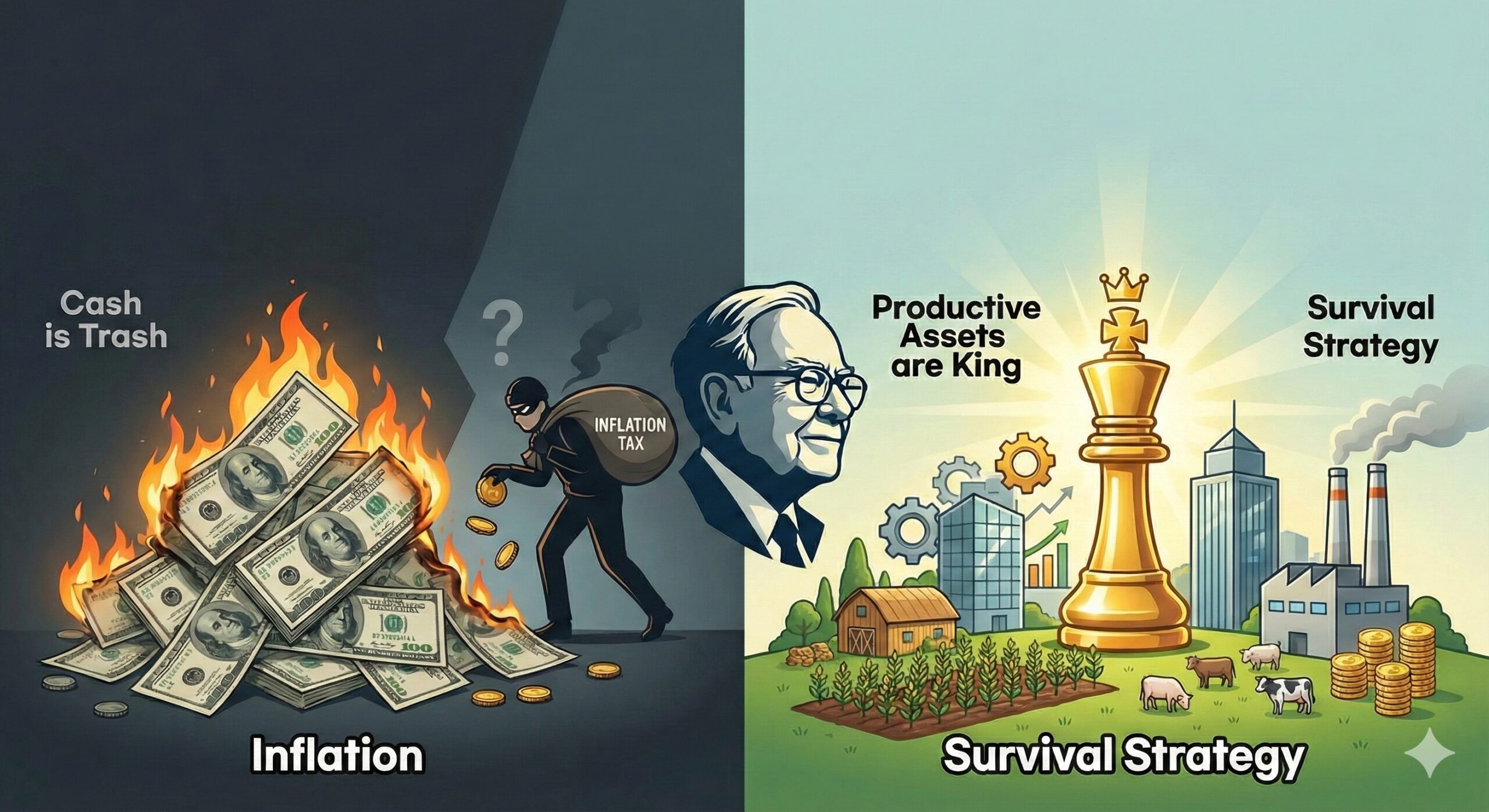
“Is Cash Trash or King?” Warren Buffett’s Guide to Capital Flow and Survival Strategies


Lan Briefing

Defining True Investment: The act of forgoing current consumption to secure greater purchasing power in the future.
The Silent Thief, Inflation: While basking in nominal returns, the “invisible tax” of inflation is quietly eroding your real wealth.
The Triumph of Productive Assets: Prioritize assets that generate value—such as farms, real estate, and businesses—over unproductive ones like gold or stagnant cash.


1. Started by the Wise, Finished by the Fool

There is an old adage in the investment world: “What the wise man does in the beginning, the fool does in the end.” This speaks to those who jump into the market only when it’s boiling over. Warren Buffett defines investing simply: it’s about skipping one hamburger today to enjoy two in the future.

However, many fall for the siren song of “instant” wealth and lose sight of this simplicity. Does a farm owner sell their land just because a fickle neighbor shouts, “Your farm’s value crashed today!”? Stocks are no different. They are not mere numbers on a chart; they are living, breathing businesses.


2. Interest Rates are Gravity: The Law of Capital Migration

Just as physics has gravity, the financial world has interest rates. When rates rise, the prices of all assets are pulled downward. The recent market turbulence is simply a manifestation of this law of gravity.

What we must focus on is capital efficiency. Buffett favors business models that create immense intangible value with minimal capital, rather than those requiring massive physical investment. It’s akin to high-yield real estate with low down payments. This structure—where your invested capital is small but the cash flow is significant—is the essence of capitalism and the “Path of Money” we should seek.


3. How to Smile in a Crisis: The 15% Buffer

By the time you hear “Cash is King,” it’s already too late. Paradoxically, the appeal of cash and bonds grows strongest when everyone else is calling cash “trash” and chasing the latest hype. Buffett consistently maintains a cash reserve of 10-15% of total assets.

This cash isn’t just sitting idle. it is high-powered ammunition to be deployed when fear permeates the market—specifically, when high-quality stocks become ridiculously cheap. Remember: in investing, fear is your friend, and euphoria is your enemy. The one who can shop calmly while others flee in panic is the one who laughs last.


📋 Lan-line Analyst’s Watch List (For Study)

Index Funds: Riding the Market’s Average Growth
* S&P 500 ETF (VOO, IVV): The most cost-effective way to enjoy the performance of America’s leading companies.

Productive Assets with Economic Moats: Superior ROIC
* Apple (AAPL): A brand-heavy model that generates massive cash flow with relatively low capital intensity.

Safety Net for Liquidity
* Short-term Treasury Bills: A tool to maintain 10-15% liquidity to seize opportunities during market drawdowns.


📊 Closing Thoughts

In the short run, the market is a voting machine—fickle and popularity-driven. In the long run, however, it is a weighing machine that accurately measures a company’s true substance. When terrifying news headlines flash, focus on the “easy” decisions. Buy great businesses, outpace the tax of inflation, and let time work its miracle. That is the most certain formula for victory that any of us can follow.

💡 Today’s Insight:

“When you treat the market as a servant rather than a master, you transition from a spectator to a true owner of wealth.”


📎 References

⚠️ Disclaimer
This content is for informational purposes only and should not be considered as investment advice. Investment decisions and their outcomes are solely the responsibility of the investor. The information provided may be inaccurate, and we do not guarantee its accuracy or profitability.

The $10 Billion Arms Race: Meta and Mistral Double Down on AI Infrastructure


Lan Briefing

Hyperscale Expansion: Meta has broken ground on a massive data center in Indiana, with total investment potential reaching $10 billion to bolster its AI roadmap.
European Sovereignty: France’s Mistral is investing €1.2 billion in a Swedish facility, signaling a push for localized AI computing power in Europe.
Infrastructure Supercycle: Equinix has raised its annual revenue forecasts, citing insatiable demand for the physical space and power required to run generative AI.


1. Meta’s $10 Billion Bet on Physical Intelligence

Meta Platforms has officially commenced construction on a state-of-the-art data center in Jeffersonville, Indiana. While initial outlays are significant, the project is designed to scale, with total expenditures projected to hit $10 billion as the company ramps up its hardware capabilities. This move underscores a critical shift: the bottleneck for AI leadership is no longer just software or silicon, but the physical capacity to house and power tens of thousands of specialized chips. As Meta integrates AI across its ecosystem, these “AI factories” represent the foundational CAPEX required to remain competitive against peers like Google and Microsoft.

2. The Shift Toward Specialized AI Real Estate

The surge in AI investment is reshaping the global real estate and power sectors. In Canada, Allied Properties is moving forward with a 10-story specialized AI data center in Vancouver, highlighting the trend of high-density vertical builds in urban hubs. Simultaneously, European players like Mistral are securing their own infrastructure—investing $1.4 billion (€1.2 billion) in Sweden—to reduce dependency on US-based cloud providers. This “land grab” for high-power-density sites indicates that the market is moving past the speculative phase and into a heavy industrial build-out. For these firms, owning the infrastructure is becoming a prerequisite for operational autonomy and data security.

3. Market Outlook: From Silicon to Power and Grid Stability

The financial implications of this build-out are already manifesting in the earnings of infrastructure providers. Equinix recently hiked its sales guidance, outperforming analyst estimates as enterprise AI demand surges. From an investment standpoint, the focus is broadening from chipmakers to the companies providing power management and cooling solutions. As data centers consume an increasing share of the global energy grid, the winners will not only be those with the fastest chips, but those who can secure reliable, high-scale power and manage the resulting thermal loads.

📋 Lan-line Analyst’s Watch List (For Study)

Data Center REITs & Operators
* Equinix (EQIX), Digital Realty (DLR)

Power & Thermal Management
* Vertiv Holdings (VRT), Eaton (ETN)

AI Compute Infrastructure
* Super Micro Computer (SMCI), Dell Technologies (DELL)

📊 Closing Thoughts

The current level of capital expenditure by Big Tech suggests a long-term conviction in the AI transition. We are witnessing a fundamental re-architecting of the global computing fabric. For investors, the takeaway is clear: the “AI trade” has evolved into an “Infrastructure trade.” Monitoring utility capacity, power grid upgrades, and specialized real estate yields will be just as vital as tracking model benchmarks in the coming quarters.

💡 Today’s Insight:

Capital does not lie. The aggressive pivot toward multi-billion dollar physical assets is the strongest leading indicator that the AI revolution is moving from the laboratory to the industrial floor.

📎 Reference Articles

⚠️ Disclaimer
This content is for informational purposes only and should not be considered as investment advice. Investment decisions and their outcomes are solely the responsibility of the investor. The information provided may be inaccurate, and we do not guarantee its accuracy or profitability.

Alphabet’s Century Bet: Buying Time to Secure Global AI Dominance


Lan Briefing

Establishing Ultra-Long-Term Capital: Alphabet has successfully raised approximately $32 billion, including the tech sector’s first 100-year “Century Bond” since Motorola in 1997.
Reaffirming Dominant Credit Status: Demand for the offering peaked at ten times the supply, signaling that the capital markets now view Alphabet’s longevity on par with Quasi-sovereign entities
Funding the Aggressive CAPEX Cycle: This strategic move secures low-cost, long-term liquidity to support an estimated $185 billion in AI-related Capital Expenditure (CAPEX) for this year alone.


1. Extending Duration: The “100-Year Trust” Bestowed on Big Tech

Historically, century bonds were the exclusive domain of sovereign states or prestigious, centuries-old academic institutions. Alphabet’s recent issuance signifies a pivot in market sentiment: capital markets are beginning to value the permanence of AI infrastructure more than the inherent volatility risks of the tech sector.

By signing onto a contract where the principal isn’t returned until the year 2126, investors are making a cold, calculated bet that Alphabet’s ecosystem will become a foundational infrastructure for human civilization. This is not merely an act of increasing debt; it is a financial manifesto declaring that tech hegemony will be extended for another century.


2. The Capital Moat: Moving Beyond R&D to “Procurement Prowess”

The current essence of the AI industry has evolved from a race of software ingenuity into a titanic war of capital firepower. Alphabet’s ability to raise $32 billion in a single day creates a formidable barrier to entry that latecomers will find nearly impossible to breach.

  • Multi-tranche Strategy: By tapping into multiple currency markets—including USD, GBP, and CHF—Alphabet maximized its investor pool while optimizing procurement costs.
  • Strategic Financial Flexibility: Issuing debt despite holding over $120 billion in cash is a masterclass in capital efficiency. This allows the company to reserve cash for R&D and shareholder returns while leveraging low-cost, long-term debt for infrastructure.
  • Structural Bargaining Power: Securing such massive funding with virtually no restrictive covenants (investor protection clauses) symbolizes Alphabet’s absolute dominance over the lending market.

3. Hyperscaler Monopolies and Macro Implications

The market’s focus is shifting from “how good is the AI model?” to “how efficiently can the company procure capital and convert it into infrastructure yield?”. The consecutive massive bond sales by hyperscalers like Alphabet and Oracle confirm that AI has matured into an infrastructure-heavy utility industry.

While these massive capital flows may create short-term volatility in interest rate markets, the long-term result is a “winner-takes-all” landscape. Only a handful of firms with the capacity to own the infrastructure will be positioned to collect the “Digital Tolls” of the AI era.


📋 Lan-line Analyst’s Watch List (For Study)

Category Key Investment Thesis Relevant Entities
AI Hyperscalers Accelerating infrastructure monopoly via capital dominance Alphabet (GOOGL), Oracle (ORCL)
Infra Value Chain Sectors where Big Tech’s massive CAPEX is directly realized as revenue NVIDIA (NVDA), Data Center Power Solutions
Ultra-Long Debt Diversifying tech portfolios and hedging on long-term rates Global Investment Banks (IBs)

📊 Closing Thoughts

Alphabet’s century bond is a formal market consensus that “AI is not a transient fad, but a paradigm shift that will define the next hundred years”. Beyond immediate profitability metrics, we must pay attention to the fact that Big Tech is utilizing its sovereign-level credit to build a moat of time and capital. As they draft this 100-year blueprint, where does your portfolio stand in their ecosystem?

💡 Today’s Insight:

“Innovation may begin with technology, but dominance is decided by the duration of capital. Alphabet isn’t just buying chips; they are buying ‘time’ itself.”


📎 Reference

  • Alphabet sells rare 100-year bond to fund AI expansion as spending surges: Detailed analysis of the $31.5B global bond sale and the rare 100-year tranche. Link
  • Alphabet Sells Almost $32 Billion Bonds as Tech Races to Fund AI: Coverage of the record-breaking bond sale and the intensifying tech race for AI funds. Link
  • Alphabet Issues 100-Year Bonds for AI Spending Spree: Examination of the $185B CAPEX plan and the long-term implications of century-long debt. Link

⚠️ Disclaimer
This content is for informational purposes only and should not be considered as investment advice. Investment decisions and their outcomes are solely the responsibility of the investor. The information provided may be inaccurate, and we do not guarantee its accuracy or profitability.

The Yen Post-Election: How Takaichinomics and the ‘Net Debt’ Pivot are Reshaping the Japanese Market


Lan Briefing

A Paradigm Shift in Fiscal Rules: The pivot from ‘Total Debt’ to a ‘Net Debt’ framework is a strategic masterstroke designed to pave the way for aggressive fiscal expansion.
The Nexus of Security and Growth: Increased defense spending and the push for energy sovereignty signal the return of a state-led “Growth First” doctrine in Japan.
Opportunity in the Policy Mismatch: We are entering a volatile yet lucrative transition where fiscal expansion clashes with monetary tightening (rate normalization). Smart capital is already positioning for this shift.


1. The Re-definition of Debt: A Sophisticated Play for Leverage

The core of the economic doctrine led by Prime Minister Takaichi lies in a fundamental “shift in perspective” regarding national debt. By moving away from the “Total Debt” narrative—which often fixates on Japan’s 250% debt-to-GDP ratio—the administration is shifting the goalposts to ‘Net Debt’ (Total Debt minus the government’s vast foreign reserves and assets).

This isn’t just a creative accounting trick. Think of it like a household that stops worrying about the mortgage principal and starts focusing on its massive savings and investment portfolio to justify taking on more leverage for growth. This shift effectively bypasses traditional fiscal constraints, providing the “green light” for massive capital injections into national defense and high-tech industries.

2. The Mechanics of Money: Expansionary Fiscal Meets Tightening Monetary

Contrary to initial market jitters about austerity, the essence of Takaichinomics is strategic expansion. Japan’s ambition to become a “normal state” with robust defense capabilities—evidenced by the deployment of F-35B stealth fighters—requires a surge in military spending, which in turn necessitates large-scale bond issuance.

For investors, the key lies in the policy mismatch. As the government pumps liquidity into the system to stimulate the economy and defense sectors, the Bank of Japan (BOJ) will be forced to accelerate interest rate hikes to defend the currency and manage inflation. We are witnessing a structural evolution where fiscal expansion paradoxically drives monetary normalization. The era of the “Yen Carry Trade” is fading, replaced by a domestic “Re-rating” of Japanese assets.

3. Investment Strategy: Policy Beneficiaries and Inflation Hedges

Warren Buffett’s massive bet on Japanese trading houses was a precursor to this “Strong Japan” scenario. As the government directs its budget toward energy, raw materials, and defense, these sectors will be the primary beneficiaries of state-led capital.

Simultaneously, the upward pressure on interest rates serves as a powerful catalyst for Japan’s “mega-banks,” whose Net Interest Margins (NIM) have been suppressed for decades. Investors must look past the surface-level volatility of the Yen and follow the “Fiscal Path” carved out by the new administration.

📋 Lan-line Analyst’s Watch List (For Study)

Defense & Infrastructure: Direct beneficiaries of fiscal expansion and defense budget hikes
* Mitsubishi Heavy Industries, Kawasaki Heavy Industries

Finance& Banking: Beneficiaries of monetary normalization and NIM expansion
* Mitsubishi UFJ Financial Group (MUFG)

General Trading Houses: Hedges for inflation and resource-driven growth
* Mitsubishi Corp., Itochu Corp.

📊 Closing Thoughts

Japan’s recent election was not merely a change in leadership; it was a declaration of intent to scale up the nation’s economic and military footprint by redefining the rules of its balance sheet. The keyword ‘Net Debt’ will serve as the most significant milestone for the Japanese capital market moving forward. For investors with a macro lens, Japan is no longer a “value trap”—it is a market being re-engineered for a new era of growth.

💡 Today’s Insight:

“A change in accounting standards is never just about math; it is a political decision to re-prioritize national goals. When the grammar of the balance sheet changes, the flow of wealth inevitably follows.”

📎 Reference

  • Japan’s Takaichi Scores Landslide Win in Election Gamble: Analysis of the LDP’s victory and its mandate for policy shifts. Link
  • Warren Buffett’s Japanese Bets Keep Paying Off: How Buffett’s long-term play aligns with Japan’s structural changes. Link
  • Japan’s election paves the way for faster tightening: Outlook on the BOJ’s rate hike trajectory following the election. Link

⚠️ Disclaimer
This content is for informational purposes only and should not be considered as investment advice. Investment decisions and their outcomes are solely the responsibility of the investor. The information provided may be inaccurate, and we do not guarantee its accuracy or profitability.