eyond the Chip: Why Your Next AI Multi-Bagger Is Hiding in the Cooling Vents


Lan Briefing

  • The “HBM Lesson” Redux: Just as there was a time lag between NVIDIA’s surge and the HBM (High Bandwidth Memory) rally, the market is currently overlooking the massive potential in physical infrastructure.

  • Thermodynamics as the New Bottleneck: High-performance AI chips are essentially high-powered furnaces; without advanced liquid cooling and robust power grids, the AI revolution hits a literal wall.

  • From Pixels to Pavements: Infrastructure giants like Comfort Systems USA and Vertiv are seeing record-breaking demand as they turn the “AI dream” into “physical reality”.

1. The Ghost of HBM: History is Rhyming Again

Remember when the market was fixated solely on NVIDIA’s stock price, oblivious to the fact that those GPUs couldn’t function without SK Hynix’s HBM? By the time the average investor realized HBM was the “secret sauce,” the massive early gains had already been booked.

We are currently in a similar “lag phase”. While the world remains obsessed with the latest chip architecture, the “smart money” is moving toward the physical constraints of AI. A chip is just a piece of silicon until it has a steady power source and a way to stay cool. If you missed the HBM boat, the infrastructure wave is your second chance to catch the cycle before it reaches peak euphoria.

2. The Cooling Crisis: Why “Chilling” is a Billion-Dollar Business

AI data centers are facing an existential crisis: Heat. Traditional air cooling is no longer sufficient for the concentrated power density of modern AI clusters. This has transformed thermal management from a boring utility into a high-growth tech sector.

Vertiv (VRT) and Modine (MOD) are no longer just industrial companies; they are the “firemen” of the AI world. With a 5-year runway of projected growth and records in order intake, companies specializing in liquid cooling are becoming indispensable partners for hyperscalers. For these tech giants, securing cooling capacity is now as critical as securing the GPUs themselves.

3. Standardizing the Chaos: The “Un-NVIDIA-ing” of the Grid

The infrastructure play isn’t just about pipes and wires; it’s about architecture and ecosystems. The emergence of the UALink (Ultra Accelerator Link) standard shows that the industry is desperate to break “vendor lock-in” and optimize how these massive data centers are built. This open standard is designed to ensure that the infrastructure remains flexible, scalable, and cost-effective.

Meanwhile, the revival of Samsung’s Exynos and the strengthening of the semiconductor ecosystem suggest that the “supportive infrastructure”—from specialized materials to advanced testing—is where the next phase of value will be captured. The strategic play isn’t just “buying the chipmaker”; it’s buying the entire ecosystem that allows the chip to function at scale.

📋 Lan-line Analyst’s Watch List (For Study)

Category The “Why” Key Watchlist Companies
Thermal Management Liquid cooling is now a “must-have” for high-density AI racks. Vertiv (VRT), Modine (MOD)
Power & Construction Massive revenue growth fueled by AI-driven data center construction. Comfort Systems USA (FIX)
Interconnects Breaking the NVLink monopoly via open standards like UALink. Broadcom (AVGO), Marvell (MRVL)
Domestic Ecosystem Supply chain ripple effects from Samsung’s mobile and AI chip revival. Semiconductor Testing & Material Leaders

📊 Closing Thoughts

Investors often fall in love with the “brain” (AI) and forget about the “body” (Infrastructure). But in the world of high-stakes technology, the body is what limits the brain. As power grids groan under the weight of AI and data centers fight to stay cool, the companies solving these physical bottlenecks will be the ones with the most sustainable moats. Stop looking for the next chip; start looking for the “shovels” that keep the mine running.

💡 Today’s Insight:

“In the AI Gold Rush, the chips are the gold, but the cooling systems and power grids are the only way to get the gold out of the mountain. Don’t let the shine blind you to the tools.”

📎 Reference Articles

  • [Reuters] Breakingviews – AI’s memory chip champion has a value problem
  • [Zacks] Riding the AI Data Center Cooling Wave: Modine’s 5-Year Runway
  • [Benzinga] Infrastructure Giant Comfort Systems USA Cashes In On AI Data Center Demand
  • [Tom’s Hardware] UALink roadmap plots course to optimized AI data center interconnects

⚠️ Disclaimer
This content is for informational purposes only and should not be considered as investment advice. Investment decisions and their outcomes are solely the responsibility of the investor. The information provided may be inaccurate, and we do not guarantee its accuracy or profitability.

[Feb 20] Higher US Inflation Fuels Fed Hawkishness; Nvidia Deepens AI Ties

1. Executive Summary

  1. U.S. inflation surprised higher in December, intensifying concerns.
  2. Federal Reserve officials expressed continued caution on rate cuts amid strong economy signals.
  3. The Supreme Court invalidated Trump-era tariffs, impacting over $175 billion in revenue.
  4. Nvidia divested its stake in Arm while pursuing a significant OpenAI investment.
  5. Nvidia and Meta expanded their multi-year AI infrastructure partnership.

2. 🌍 Global Market

📉 Global Outlook

US Inflation Heats Up, Fed Rate Cut Bets Fade

US Personal Consumption Expenditures (PCE) inflation for December exceeded expectations, yet remains above the Federal Reserve’s 2% target, prompting Atlanta and Dallas Fed Presidents to voice concerns about the strong economy and persistent inflation. This data and hawkish commentary have significantly diminished expectations for early Fed rate cuts, leading the dollar to its best weekly performance since October. Consequently, these inflationary pressures and the Fed’s cautious stance are expected to push back market expectations for interest rate reductions and exert upward pressure on bond yields.

Supreme Court Strikes Down Trump-Era Tariffs

The US Supreme Court ruled against former President Donald Trump’s “reciprocal tariffs” imposed without Congressional approval, a decision that could trigger $100 billion to $175 billion in refunds. While the Court found that the President exceeded his authority under the International Emergency Economic Powers Act (IEEPA), the Treasury indicated it would utilize other trade authorities, such as Sections 232 and 301. This ruling could fundamentally undermine Trump’s trade strategies, leading to immediate declines in Treasury yields and a weaker dollar, though future trade policy uncertainty persists due to the potential for alternative measures.

Escalating Geopolitical Tensions Between US and Iran

The United States has amassed significant military assets, including two aircraft carriers and dozens of fighter jets, near Iran, sharply escalating military tensions in the Middle East. This deployment coincides with reports that former President Trump is considering limited strikes to coerce Iran into a nuclear deal, suggesting a growing risk of military confrontation in the region. Such geopolitical instability is poised to heighten concerns over global energy supply chains and increase volatility across international oil and financial markets.

Oil Prices Respond to Mideast Unrest and Supply Shifts

International oil prices surged to a six-month high, with Brent crude surpassing $71 per barrel, driven by escalating US-Iran geopolitical tensions and mounting concerns over potential Strait of Hormuz closures. Concurrently, global supply dynamics are shifting, with Spain’s Repsol planning to triple Venezuelan oil output after securing a US permit, and a $90 billion Russian oil smuggling ring being exposed. While geopolitical premiums and supply uncertainties will maintain oil price volatility, potential increases in supply could partially offset upward price pressures.

US-China Military Standoff Near South Korea

US and Chinese fighter jets briefly confronted each other in international airspace near South Korea, as reported by Yonhap News Agency. This incident underscores the intensifying military rivalry between the major powers in the Indo-Pacific region and highlights potential flashpoints. Such military encounters can exacerbate regional geopolitical tensions, potentially negatively influencing investor sentiment towards stability in key Asian markets.

🚀 Market (Stock/Indices)

Etsy Divests Depop, Reshapes Portfolio

Etsy sold its second-hand clothing platform Depop to eBay for $1.2 billion, realizing a significant loss from its 2021 acquisition price of $1.62 billion. This strategic move reflects Etsy’s pivot to focus on core business and portfolio re-evaluation as e-commerce growth slows post-pandemic. The divestiture is expected to enhance Etsy’s financial flexibility and strengthen eBay’s position in the pre-owned fashion market.

Walmart Shares Dip on Muted Guidance

Walmart reported better-than-expected Q4 EPS and revenue, driven by strong U.S. comparable store sales and e-commerce growth, yet its stock fell 3% after hours. The decline was triggered by the company’s full-year guidance falling short of analyst estimates, signaling investor concerns about future profitability and growth momentum. This suggests that while Walmart remains a retail powerhouse, its short-term stock performance may be impacted by cautious outlooks.

Amazon Overtakes Walmart in Annual Revenue

Amazon has for the first time surpassed Walmart as the world’s leading company by annual revenue. This milestone underscores Amazon’s relentless expansion across e-commerce, cloud computing (AWS), and digital advertising, enabling it to achieve unprecedented scale. Amazon’s revenue leadership solidifies its dominant position in the global economy and marks a significant shift from traditional retail to diversified digital and tech services.

Bitcoin Futures Hint at Slowing Price Surge

Bitcoin futures data suggests a potential moderation in the cryptocurrency’s recent rapid price appreciation. This indication from the derivatives market often reflects cautious institutional investor sentiment and hedging activities following a substantial rally. The futures market implies that extreme bullish momentum may temper, potentially leading to a more stable or consolidative phase for Bitcoin.

Eric Trump Predicts $1M Bitcoin

Eric Trump reiterated his strong conviction that Bitcoin’s price will ultimately reach $1 million, citing its historical average annual growth of approximately 70% over the past decade. This optimistic long-term outlook is fueled by beliefs in Bitcoin’s increasing adoption, inherent scarcity, and potential as a store of value. Such high-profile endorsements contribute to a positive long-term sentiment among investors, fostering bullish expectations despite short-term volatility.

‘Bitcoin Death Cross’ Fears Resurface

Speculation about a “Bitcoin death cross” has re-emerged, causing a surge in Google searches for “0 dollar fall” amidst heightened market fear. A death cross, a technical analysis pattern, often signals potential downward price momentum, triggering panic among less experienced investors. While technical indicators can influence sentiment, Bitcoin’s fundamental drivers and long-term investor conviction may mitigate severe downside, though short-term volatility could persist due to fear-driven selling.

Global Equity Funds Attract Record Inflows on AI Optimism

Global equity funds recorded their largest inflows in five weeks, with U.S. equity funds leading this significant trend. This surge in investment is largely attributed to an easing of concerns surrounding Artificial Intelligence (AI) and sustained positive market sentiment towards the technology sector. The consistent capital inflow suggests renewed investor confidence in the equity market, particularly in growth-oriented segments, potentially driving further market gains.

European Stocks See Record Inflows as US Tech Alternatives

Investors are funneling record sums into European stocks, with February poised to mark an all-time high in inflows. Global fund managers are actively seeking alternatives to potentially overvalued U.S. tech shares, finding European markets more attractive in terms of valuation. This diversification trend indicates a shift in capital flows as investors seek better value opportunities abroad, which could bolster European equities and temper the dominance of U.S. tech.

Precious Metals Climb Following Tariff Ruling

Precious metals settled higher after a recent tariff ruling, signaling a positive market reaction. The tariff decision likely introduced elements of economic uncertainty or currency fluctuation, traditionally boosting demand for safe-haven assets such as gold and silver. This upward movement suggests that geopolitical and trade policy developments continue to be significant drivers for precious metal prices, warranting close monitoring.

Newmont CEO Prioritizes Margins Amidst Record Gold Prices

Newmont’s CEO emphasized prioritizing margins over being “starry-eyed” about record gold prices, signaling a strong focus on operational efficiency. This strategic stance reflects a disciplined approach to leveraging high gold prices, aiming to maximize profitability through cost control and prudent capital allocation rather than aggressive expansion. The emphasis on margin protection indicates that major gold producers may not significantly increase supply despite elevated prices, potentially supporting sustained high price levels in the long term.

🤖 Tech (AI/Semiconductors)

NVIDIA’s Strategic Portfolio Adjustments

NVIDIA has divested its entire stake in Arm, a UK-based semiconductor design company it once sought to acquire, while reports suggest its potential investment in OpenAI could be adjusted downwards from an initially speculated $100 billion to $30 billion. The Arm divestiture follows a failed acquisition attempt in 2022 due to regulatory hurdles, signaling a strategic refocus, while the OpenAI investment recalibration reflects ongoing fundraising complexities and market dynamics. These portfolio adjustments underscore NVIDIA’s intent to concentrate resources on core AI technology development and strategic partnerships, solidifying its market leadership and standard-setting within the AI ecosystem.

NVIDIA Expands AI Infrastructure Partnerships

NVIDIA is actively expanding its AI ecosystem through strategic collaborations, including an extended multi-year AI infrastructure partnership with Meta and a new alliance with Texas Tech University to build next-generation AI infrastructure. These partnerships are driven by Meta’s accelerating AI development needs and Texas Tech’s demand for advanced research capabilities, enabling NVIDIA to broaden the adoption of its core AI chips and platform. Such collaborations will help NVIDIA secure stable demand for its AI chips, extend its influence across various industries and academic sectors, and reinforce its long-term market dominance.

NVIDIA Broadens Product Portfolio Amid Intensifying Competition

NVIDIA is expanding its product portfolio, enabling general users to run high-performance AI models with its GB10 Superchip, launching the open-source robot world model DreamDojo, and exploring entry into Intel and AMD’s CPU market. This strategic push responds to the increasing everyday use of AI and advancements in robotics, alongside a drive to optimize performance through integrated AI workloads that transcend traditional market boundaries. While these moves position NVIDIA to extend its dominance from AI hardware into software and platforms, securing new growth drivers, the company faces intensifying direct competition from major tech giants like Google.

Google Gemini AI Model and Service Expansion

Google has launched Gemini 3.1 Pro, a next-generation AI model boasting double the reasoning performance, while also integrating AI music generation tools, linking with Google Maps, and expanding data integration for cloud AI agents. These developments are part of Google’s strategic effort to continuously enhance AI model capabilities and strengthen multimodal features, addressing diverse user scenarios and enterprise demands. The rollout of Gemini 3.1 Pro is expected to significantly boost Google’s AI competitiveness and expand its influence in both AI democratization and the enterprise AI solutions market through extensive service integrations.

Advancements in AI Data Center Infrastructure

Demand for AI data centers is fueling improved performance for infrastructure companies like Comfort Systems USA, while Modine projects long-term growth in AI data center cooling systems. This surge is driven by the escalating power consumption and heat generation from high-performance AI chips, necessitating increasingly efficient cooling and power solutions. This trend presents sustained growth opportunities for companies involved in AI data center construction, operation, and advanced cooling technologies, thereby bolstering the physical foundation for AI technology proliferation.

Resurgence of Samsung Exynos and Impact on Korean Semiconductor Ecosystem

Samsung Foundry’s Exynos application processors are slated for integration into the upcoming Galaxy S26 series, sparking optimism for improved earnings among suppliers of related materials and testing solutions. This resurgence is attributed to Samsung Mobile eXperience (MX) division’s decision to re-adopt Exynos coupled with advancements in Samsung’s foundry technology, enhancing the chip’s competitiveness. The revival of Exynos is expected to create significant synergy within Samsung’s internal semiconductor business and positively impact the entire domestic semiconductor materials, parts, and equipment (MPE) ecosystem, driving growth for associated companies.

🌏 Region (China/Eurozone)

German Manufacturing Rebound Boosts Eurozone Activity

German manufacturing activity unexpectedly rebounded, driving broader business activity across the Eurozone and signaling a potential turnaround for the region’s largest economy. The improved performance is attributed to stabilizing energy prices, easing supply chain constraints, and a gradual recovery in global demand, alongside anticipation of shifting monetary policy. A sustained recovery in German manufacturing could bolster the Eurozone’s overall economic momentum, positively impacting European equity markets and potentially alleviating pressure on the ECB regarding immediate interest rate cuts.

China Reroutes Drone Exports to Russia via Thailand to Evade Sanctions

China is reportedly utilizing a new route through Thailand to export drones to Russia, a move interpreted as an attempt to circumvent Western sanctions and highlighting ongoing military cooperation. This redirection of drone exports through a third country became necessary as Western nations intensified sanctions against Russia following the invasion of Ukraine, prompting China to find alternative supply channels. This circumvention strategy is likely to escalate geopolitical tensions and could provoke further sanctions from Western powers against China, introducing increased uncertainty for global trade dynamics and specific technology companies.

By Lan Analyst at 2026-02-21 07:05:00

⚠️ Disclaimer
This report is for informational purposes only and does not constitute investment advice.
While based on reliable sources, accuracy is not guaranteed.
All investment decisions are the sole responsibility of the investor.


Kevin Warsh’s “Dual Mandate” & Trump’s $200B MBS Injection: Is a New Liquidity Cycle Beginning?


Lan Briefing

Fed Chair nominee Kevin Warsh is proposing a “tapering plus rate cuts” strategy: aggressive rate cuts paired with active Quantitative Tightening (QT) to lean out the Fed’s $6.7 trillion balance sheet.
Warsh argues that AI-driven productivity gains will act as a significant disinflationary force, allowing the Fed to cut rates without triggering a rebound in inflation.
In a strategic “cushion” move, the Trump administration has directed Fannie Mae and Freddie Mac to purchase $200 billion in mortgage-backed securities (MBS), aimed at driving down borrowing costs.


1. The Warsh Doctrine: Balancing the Accelerator and the Brake

The financial world is currently parsing the “Warsh Doctrine”—a policy stance that seems contradictory at first glance. Kevin Warsh, the nominee for Fed Chair, intends to initiate front-loaded interest rate cuts while simultaneously shrinking the central bank’s massive portfolio of bonds through active QT.

By cutting rates (the accelerator) and maintaining QT (the brake), Warsh aims to lower the cost of capital for the broader economy while removing excess liquidity to maintain policy credibility. His core thesis relies on the idea that we are entering a productivity boom led by Artificial Intelligence, which could replicate the 1990s era of high growth and low inflation. He believes that a 1-percentage-point increase in annual productivity growth could double standards of living within a generation, providing the Fed more room to ease.

2. The Treasury’s “Cushion” Strategy: Bypassing the Fed

While the Fed focuses on leaning out its balance sheet, the Trump administration is opening a secondary liquidity tap. President Trump recently directed mortgage giants Fannie Mae and Freddie Mac to purchase $200 billion in mortgage-backed securities (MBS) to further drive down borrowing costs for American families.

This move is a strategic “bank shot” in financial engineering. As the Fed allows its MBS holdings to roll off (tightening), the administration’s intervention in the secondary mortgage market is intended to keep money flowing and rates low for everyday Americans. While some analysts suggest the ultimate impact may be modest—estimated at a 10 to 15 basis point dip in mortgage rates—the move functions as a short-term policy stimulant comparable to quantitative easing (QE) by increasing bond demand.

3. Market Outlook: Selective Liquidity and Strategic Shifts

For investors, the takeaway is clear: the era of “unconstrained” liquidity is shifting toward “targeted” liquidity. The combined effect of anticipated rate cuts and government asset purchases suggests a market where the downside is protected, but the upside is reserved for sectors demonstrating real productivity.

We are likely to see a focus on interest-sensitive sectors like housing and small-caps, which stand to benefit from lower borrowing costs. However, the long-term winners will be companies that can leverage the AI revolution to prove Warsh’s productivity thesis. Analysts suggest balancing dollar-strength benefits in early 2026 with a shift toward tech and green energy leaders as rate cuts accelerate in the second half of the year.


📋 Analyst’s Watch List (For Educational Use)

Housing & Real Estate Finance: Primary beneficiaries of the $200B GSE buying mandate and falling mortgage rates.
* Fannie Mae (FNMA), Freddie Mac (FMCC), and Homebuilder ETFs (ITB).

AI & High-Productivity Tech: Sectors Warsh views as the “disinflationary engine” of the new economy.
* NVIDIA (NVDA), and leading AI infrastructure firms.

Financials & Small-Caps: Positioned to capitalize on lower borrowing costs and traditional banking models.
* Regional Bank ETFs and the Russell 2000.


📊 Closing Thoughts

The policy mix of 2026 is an intricate balancing act. While the Fed officially attempts to “normalize” its balance sheet through active QT, the administration is utilizing GSE mandates to provide a liquidity cushion. Investors should look past the “tightening” headlines and follow the actual flow of assets; when the Treasury provides a buffer, the “Fed Brake” may be less restrictive than it appears.

💡 Today’s Insight:

“When the central bank pulls back and the government steps in, the liquidity doesn’t disappear—it simply changes its point of entry. Watch the GSEs, not just the Fed.”


📎 References

  • New Fed Chair Warsh Takes Office: Major Shift in Monetary Policy? : Analysis of the “tapering plus rate cuts” strategy. Link
  • Trump Touts Housing Wins In Georgia Economic Speech : Coverage of the $200B MBS purchase directive for Fannie and Freddie. Link
  • Trump’s $200B MBS Purchase Plan: Short-Term Housing Rally, Long-Term Risks : Market impact and transmission mechanism of the MBS buy. Link
  • Fed officials at odds over AI’s impacts on monetary policy : Kevin Warsh’s stance on AI as a disinflationary force. Link

⚠️ Disclaimer
This content is for informational purposes only and should not be considered as investment advice. Investment decisions and their outcomes are solely the responsibility of the investor. The information provided may be inaccurate, and we do not guarantee its accuracy or profitability.

[Feb 19] Nvidia Divests Arm Stake, Accelerates AI; Fed Signals Inflation Fears

1. Executive Summary

  1. Nvidia fully divested its stake in Arm.
  2. Nvidia aggressively expands AI partnerships and hints at groundbreaking new chips.
  3. US weekly jobless claims fell sharply, signaling labor market strength.
  4. The US trade deficit widened, and Q4 GDP growth was revised lower.
  5. Fed minutes showed renewed inflation worries, with some officials considering rate hikes.

2. 🌍 Global Market

📉 Global Outlook

📉 Macro (Economy/Rates)

Fed’s Hawkish Stance and Bond Market Reaction

The January FOMC minutes revealed renewed inflation concerns among some officials, with a few even pondering a rate hike, leading to a rise in U.S. Treasury yields. This hawkish tilt reflects the Federal Reserve’s apprehension about persistent inflationary pressures and robust economic data, dampening market expectations for imminent rate cuts. Markets are pricing in a delayed timeline for rate reductions, suggesting continued volatility in bond markets as investors adjust to a more cautious Fed stance.

Continued Strength in US Labor Market

U.S. weekly jobless claims dropped by 23,000 to 206,000, marking the largest decline since November and falling below market expectations. This indicates a resilient labor market where employers are largely retaining staff amidst stable economic conditions. Strong employment figures could reinforce the Federal Reserve’s cautious stance on monetary easing, potentially further delaying anticipated interest rate cuts.

Expansion of US Trade Deficit

The U.S. annual trade deficit swelled to $901.5 billion last year, marking one of its largest gaps since 1960, driven by a surge in imports. This expansion primarily stems from robust domestic demand fueling import growth, while export expansion lagged comparatively. A widening trade deficit might temper some dollar strength, yet the underlying strong domestic consumption could sustain inflationary pressures, complicating the Fed’s path toward monetary easing.

Downward Revision of US Q4 GDP Growth

The Atlanta Fed’s ‘GDPNow’ model significantly lowered its estimate for Q4 U.S. economic growth from 3.6% to 3.0% just one day before the official release. This revision reflects the incorporation of recent economic data, suggesting a potential moderation in growth momentum compared to earlier projections. While the downward revision might slightly ease concerns about an overheating economy, the growth rate remains robust, likely having only a limited impact on immediate rate-cut expectations.

US-Iran Geopolitical Tensions and Rising Oil Prices

Geopolitical tensions between the U.S. and Iran have intensified, driving up global oil prices and fueling broader inflation concerns. This reflects market anxieties over potential supply disruptions in the Middle East, leading to increased uncertainty regarding crude oil availability. Sustained geopolitical risks are expected to keep upward pressure on oil prices, potentially influencing central bank decisions on the pace of rate cuts and dampening inflation moderation hopes.

Strong Demand for US 30-Year TIPS

A $9 billion auction of 30-year U.S. Treasury Inflation-Protected Securities (TIPS) drew robust demand, resulting in a yield significantly below market expectations. This strong investor appetite indicates a persistent demand for long-term inflation hedges, suggesting that inflation expectations remain embedded in the market. Sustained TIPS demand underscores the market’s awareness of long-term inflation risks, reinforcing that the inflation trajectory will remain a critical factor in the Federal Reserve’s policy decisions.

Stability in the Gold Market

Gold prices remained largely stable despite rising geopolitical tensions between the U.S. and Iran, with investors largely focused on upcoming inflation data. Geopolitical risks offered some support to gold, but market participants adopted a wait-and-see approach, keenly awaiting inflation figures that could influence the Fed’s monetary policy. Gold is expected to retain its safe-haven appeal amid geopolitical uncertainties, though its short-term price movements will likely be highly sensitive to forthcoming inflation reports.

Decline in Copper Prices

Copper prices declined following the release of the Fed’s January FOMC minutes, which indicated officials’ caution regarding interest rate cuts. The hawkish Federal Reserve stance heightened concerns about potential economic growth slowdowns, consequently implying reduced industrial demand for the metal. A prolonged period of tight monetary policy from the Fed could continue to weigh on industrial metal prices like copper, creating uncertainty for demand-side fundamentals.

US Uranium Policy Shift

The U.S. announced its intent to phase out Russian uranium and is pursuing a $2.25 billion initiative to restore an independent domestic nuclear fuel supply chain, impacting major commodity markets. This strategic move by the Biden administration aims to bolster energy security and reduce reliance on Russia following its invasion of Ukraine. This policy shift is expected to accelerate the restructuring of the global uranium supply chain and could create long-term opportunities for non-Russian uranium producers.

🚀 Market (Stock/Indices)

U.S. Equities Decline Amid Market Instability

U.S. major indices broadly declined due to a combination of factors, including a pullback in NVIDIA and private equity stocks, a rise in oil prices (Brent above $70), and geopolitical concerns related to Iran. This downturn was exacerbated by diminished rate-cut expectations following the January FOMC minutes, leading the ‘Wall Street Fear Index’ (VIX) to again surpass 20, amplifying market anxiety. Investors are showing increased sensitivity to geopolitical risks and monetary policy uncertainties, suggesting elevated market volatility may persist in the near term.

Sustained Foreign Investment in U.S. Assets

Foreign investors continued to acquire U.S. assets, making net purchases of $1.6 trillion, thereby resisting a “Sell America” narrative. This influx of foreign capital reflects confidence in the long-term growth potential and attractiveness of the U.S. economy, separate from recent market downturns. The sustained global capital inflow indicates that the U.S. market remains a compelling investment destination, potentially serving as a supportive foundation for U.S. asset markets going forward.

Bitcoin Price Correction and Extreme Fear Sentiment

Bitcoin’s price dipped back below 100 million Korean Won (approximately $75,000 USD equivalent) after a brief recovery during the Lunar New Year holiday, pushing the Crypto Fear & Greed Index to an “extreme fear” level of 8. This price adjustment stemmed from hawkish interpretations of the January Federal Open Market Committee (FOMC) meeting minutes, which reignited concerns about potential interest rate hikes and dampened investor appetite for high-risk assets. Consequently, the Bitcoin market is expected to remain highly sensitive to macroeconomic indicators and shifts in monetary policy, maintaining elevated volatility for the foreseeable future.

🤖 Tech (AI/Semiconductors)

NVIDIA’s AI Chip Strategy and Partnership Expansion

NVIDIA has divested all its shares in British chip designer Arm, which it once sought to acquire, while CEO Jensen Huang teased “chips the world has never seen before” for GTC. This strategic move appears to reallocate capital towards core AI chip development and direct industry partnerships. NVIDIA is poised to solidify its dominance in the AI hardware market and accelerate integration across various sectors, leveraging resources from the Arm divestment and upcoming next-generation chips.

AI Industry Investment, Tech Development & Market Trends

OpenAI’s latest funding round is projected to exceed $100 billion, while chip startup Taalas raised $169 million to develop AI chips challenging NVIDIA. Concurrently, Wall Street is accelerating the “financialization of AI” by exploring GPU derivatives and collateralized debt based on computing power. This massive capital injection underscores the critical need for AI infrastructure and indicates a rapidly maturing and expanding AI industry. Expect heightened technological innovation and financial product structuring across the AI hardware and software ecosystem going forward.

Tesla Commences Production of Cybercab Robotaxi

Tesla has officially rolled out its dedicated self-driving robotaxi, Cybercab, from the Giga Texas production line, a model designed without a steering wheel or pedals for full autonomy. This move signifies Tesla’s aggressive shift from its limited Model Y-based robotaxi service towards a fully driverless system. While Cybercab’s commercialization holds the potential to disrupt traditional transportation, its success hinges on securing regulatory approvals, rigorous safety validation, and gaining widespread public trust.

Major Semiconductor Firms and Memory Supply Chain Updates

TSMC confirmed up to $56 billion in capital expenditure this year, commencing construction of five fabs simultaneously, driven by robust AI demand, while Intel shares slid as Meta reportedly secured more NVIDIA AI chips. Simultaneously, memory supply shortages, particularly for High-Bandwidth Memory (HBM), continue to intensify due to surging AI chip demand, boosting stock prices for major memory manufacturers like Samsung Electronics and SK Hynix. This dynamic indicates that an AI-centric semiconductor market is highly favorable for foundries and memory providers, yet poses competitive challenges for traditional Integrated Device Manufacturers (IDMs).

🌏 Region (China/Eurozone)

IMF Urges China to Shift to Consumption-Led Growth

The International Monetary Fund (IMF) has advised China to transition its economy from an investment and export-driven model to one led by consumption. This recommendation comes as China’s traditional growth strategy faces mounting domestic structural challenges and global trade tensions. A successful pivot could foster more sustainable long-term growth for China, whereas a failure might exacerbate internal imbalances and global economic uncertainty.

Global Shipping Industry Consolidates with Key Acquisition

Germany’s fifth-largest shipping company has acquired the tenth-largest firm, signaling a potential wave of consolidation within the global shipping industry. This strategic move likely aims to boost operational efficiency, expand market share, and navigate persistent challenges such as overcapacity and volatile freight rates. Increased M&A activity in the sector could lead to higher market concentration, potentially stabilizing freight prices and improving profitability for major players.

By Lan Analyst at 2026-02-20 07:10:47

⚠️ Disclaimer
This report is for informational purposes only and does not constitute investment advice.
While based on reliable sources, accuracy is not guaranteed.
All investment decisions are the sole responsibility of the investor.

[Feb 18] Fed Divided on Rates as AI Stocks Surge, Geopolitical Tensions Lift Oil

1. Executive Summary

  1. Fed officials are split on future interest rate adjustments.
  2. AI’s productivity gains may push the neutral interest rate higher.
  3. Nvidia and other AI-related tech stocks led market gains.
  4. Oil prices jumped 4% due to rising Middle East tensions.

2. 🌍 Global Market

📉 Global Outlook

Fed Minutes Reveal Divided Stance on Monetary Policy

The January FOMC minutes showed a clear divergence among Federal Reserve officials regarding the future path of interest rates, with some even discussing a scenario for rate hikes. This split in views was accompanied by discussions on how advancements in artificial intelligence (AI) could potentially raise the neutral rate. Consequently, the Fed’s monetary policy is expected to remain highly data-dependent, perpetuating market uncertainty.

Fed Cautions on Uneven Inflation Progress

Federal Reserve officials issued a warning that progress toward their inflation target would likely be “uneven.” This reflects an acknowledgment of the persistent risk that price growth could remain above the 2% objective. As a result, the Fed is anticipated to maintain a cautious approach to rate cuts, prioritizing sustained evidence of inflation moderation.

Oil Prices Surge Amid Middle East Tensions and Russian Supply Concerns

International oil prices jumped 4% following escalating tensions between the U.S. and Iran, coupled with reports of declining Russian oil drilling due to funding issues. The potential for a full-scale conflict between the U.S. and Iran, alongside fears of compromised Russian output, served as primary catalysts for the price surge. Ongoing geopolitical risks could sustain upward pressure on energy costs, potentially contributing to global inflationary pressures.

US Treasury Yields Continue Upward Trend

U.S. Treasury yields rose across the curve after the release of the divided Fed minutes and stronger-than-expected economic data. This movement suggests market participants are pricing in a ‘higher for longer’ stance from the Fed and robust U.S. economic performance. Rising bond yields will increase borrowing costs for businesses and consumers, impacting the broader financial market environment.

Robust US Economic Activity Indicators Released

U.S. industrial production recorded its largest increase in nearly a year, and capital goods orders surged in December, partly driven by significant investments in AI infrastructure. This growth, coupled with an unusual “jobless boom” scenario, signals underlying strength in the U.S. economic expansion. Strong economic activity will influence the Fed’s monetary policy decisions while also raising questions about labor market dynamics and potential for overheating.

🚀 Market (Stock/Indices)

Global Markets Surge on AI Tech Leadership

Global stock markets, particularly on Wall Street, experienced a significant rally, predominantly fueled by the robust performance of AI-related technology stocks such as Nvidia. This rebound stemmed from an abatement of previous AI-related jitters, coupled with strong economic reports and sustained retail investor interest in software companies. The continued strength in the tech sector, especially within AI, suggests that investor confidence in growth narratives remains resilient, potentially offsetting broader macroeconomic concerns and sustaining market momentum.

Markets Absorb FOMC Rate Hike Scenarios, Close Higher

Global equities concluded higher despite the release of FOMC minutes indicating a surprising discussion of a potential scenario for further interest rate hikes. This market resilience suggests investors are either calmly processing the information or finding sufficient support from strong corporate earnings and AI-driven growth narratives to counteract hawkish monetary policy signals. While the initial market reaction to the FOMC minutes carried some concern, the subsequent higher close indicates that investors are increasingly looking beyond immediate rate worries, focusing on long-term growth potential, though bond markets show sensitivity to AI productivity speculation.

🤖 Tech (AI/Semiconductors)

NVIDIA & Meta Deepen AI Partnership

NVIDIA and Meta have expanded their multi-year partnership, securing a deal for millions of AI chips, including Blackwell and Rubin generations. This intensified collaboration is driven by Meta’s pursuit of “superintelligence” and its massive AI infrastructure build-out, exemplified by AI integration in WhatsApp, where NVIDIA’s chips are optimally suited for Meta’s existing tech ecosystem. The agreement solidifies NVIDIA’s dominance in AI chip supply and ensures Meta’s sustained access to critical computing power, vital for its continuous AI innovation.

NVIDIA Strategic Moves Post-ARM

NVIDIA is divesting its stake in Arm, a company it once sought to acquire, while simultaneously showcasing up to 50x better performance with its next-gen Blackwell Ultra chips and strengthening its HBM supply chain. This reflects a strategic pivot post-failed Arm acquisition, focusing on core AI chip and graphics IP development, and securing advanced components like HBM crucial for next-generation AI systems. These actions are poised to streamline NVIDIA’s business, reinforcing its AI leadership through superior performance and strategic component sourcing, potentially sparking new debates on CPU strategies in the agentic AI era.

Microsoft Accelerates AI & Cloud Expansion

Microsoft is accelerating its AI and cloud footprint, committing $50 billion to AI initiatives in the ‘Global South’ and securing 20% of OpenAI’s revenue. This aggressive strategy aims to reinforce Microsoft’s position as a premier AI and cloud provider, expanding its global market reach and deepening integration with leading-edge AI models from OpenAI. Such substantial investments are expected to drive significant growth in Microsoft’s Azure cloud services and AI-powered offerings.

Global Semiconductor Industry Outlook Improves

The global semiconductor industry is experiencing a robust recovery, marked by a 16% surge in equipment manufacturer revenue driven by explosive AI chip investments and rising memory prices, with Micron expanding HBM production. This strong growth is fueled by unprecedented demand for AI chips, a broad recovery in the memory market, and emerging applications like humanoid robot chips. The sector is set for continued strong performance, particularly in AI-related segments, though potential supply bottlenecks and rapidly escalating component costs could impact downstream IT device production.

AI Infrastructure & Data Center Investments Expand

India is boosting its AI infrastructure with L&T partnering NVIDIA to build a gigawatt-scale AI factory under the IndiaAI mission, alongside major data center expansions in regions like Utah targeting 600MW for AI. These initiatives stem from escalating global demand for AI computing power and the strategic imperative for nations to build domestic AI capabilities, necessitating massive investments in energy-intensive data centers and advanced connectivity. Such large-scale infrastructure projects are critical for future AI development and deployment, indicating a continued boom in data center construction and related power solutions to support the burgeoning AI industry.

🌏 Region (China/Eurozone)

Taiwan’s Robust Economic Growth Driven by AI Boom

Taiwan’s economy is projected to achieve a 7.71% growth rate this year, with a per capita GDP reaching $44,000, significantly surpassing that of South Korea. This surge is primarily fueled by the global demand for AI technologies and Taiwan’s dominant position in the semiconductor industry. Such strong performance is expected to solidify Taiwan’s status as a leading technology hub in Asia, attracting further foreign direct investment into its high-tech sectors.

Japan’s US Investment Confirmed, Mounting Pressure on South Korea

Japan has finalized its initial major investment projects in the US, committing to energy and infrastructure sectors, including oil and gas ventures in Texas and an artificial diamond factory in Ohio. This investment aligns with the US’s strategic objectives for energy security and critical infrastructure development, setting a precedent for allied nations. Consequently, the US is anticipated to increase pressure on South Korea to present similar strategic investment packages, potentially focusing on nuclear power and other key infrastructure.

South Korea’s Strategy Against China’s Market Offensive

South Korea is moving to counter China’s volume-driven competition in critical industries, specifically offshore wind energy, by pursuing economies of scale through policies like the “sea wind law.” This strategic response is aimed at addressing China’s aggressive market penetration and cost advantages in manufacturing and industrial output. Such measures are likely to lead to increased government support and robust regulatory frameworks designed to protect and bolster domestic players in the clean energy sector.

By Lan Analyst at 2026-02-19 07:12:34

⚠️ Disclaimer
This report is for informational purposes only and does not constitute investment advice.
While based on reliable sources, accuracy is not guaranteed.
All investment decisions are the sole responsibility of the investor.

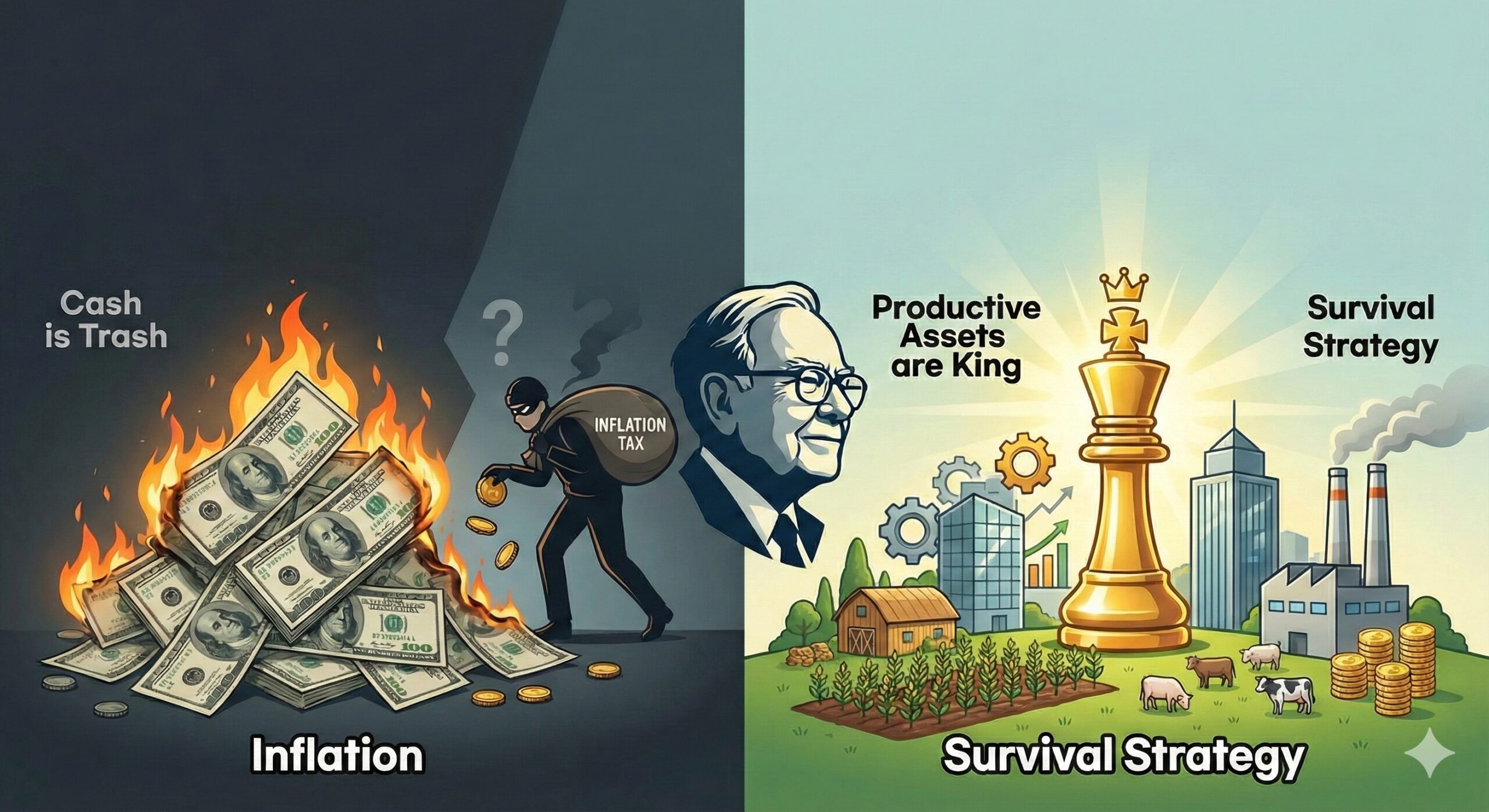
“Is Cash Trash or King?” Warren Buffett’s Guide to Capital Flow and Survival Strategies


Lan Briefing

Defining True Investment: The act of forgoing current consumption to secure greater purchasing power in the future.
The Silent Thief, Inflation: While basking in nominal returns, the “invisible tax” of inflation is quietly eroding your real wealth.
The Triumph of Productive Assets: Prioritize assets that generate value—such as farms, real estate, and businesses—over unproductive ones like gold or stagnant cash.


1. Started by the Wise, Finished by the Fool

There is an old adage in the investment world: “What the wise man does in the beginning, the fool does in the end.” This speaks to those who jump into the market only when it’s boiling over. Warren Buffett defines investing simply: it’s about skipping one hamburger today to enjoy two in the future.

However, many fall for the siren song of “instant” wealth and lose sight of this simplicity. Does a farm owner sell their land just because a fickle neighbor shouts, “Your farm’s value crashed today!”? Stocks are no different. They are not mere numbers on a chart; they are living, breathing businesses.


2. Interest Rates are Gravity: The Law of Capital Migration

Just as physics has gravity, the financial world has interest rates. When rates rise, the prices of all assets are pulled downward. The recent market turbulence is simply a manifestation of this law of gravity.

What we must focus on is capital efficiency. Buffett favors business models that create immense intangible value with minimal capital, rather than those requiring massive physical investment. It’s akin to high-yield real estate with low down payments. This structure—where your invested capital is small but the cash flow is significant—is the essence of capitalism and the “Path of Money” we should seek.


3. How to Smile in a Crisis: The 15% Buffer

By the time you hear “Cash is King,” it’s already too late. Paradoxically, the appeal of cash and bonds grows strongest when everyone else is calling cash “trash” and chasing the latest hype. Buffett consistently maintains a cash reserve of 10-15% of total assets.

This cash isn’t just sitting idle. it is high-powered ammunition to be deployed when fear permeates the market—specifically, when high-quality stocks become ridiculously cheap. Remember: in investing, fear is your friend, and euphoria is your enemy. The one who can shop calmly while others flee in panic is the one who laughs last.


📋 Lan-line Analyst’s Watch List (For Study)

Index Funds: Riding the Market’s Average Growth
* S&P 500 ETF (VOO, IVV): The most cost-effective way to enjoy the performance of America’s leading companies.

Productive Assets with Economic Moats: Superior ROIC
* Apple (AAPL): A brand-heavy model that generates massive cash flow with relatively low capital intensity.

Safety Net for Liquidity
* Short-term Treasury Bills: A tool to maintain 10-15% liquidity to seize opportunities during market drawdowns.


📊 Closing Thoughts

In the short run, the market is a voting machine—fickle and popularity-driven. In the long run, however, it is a weighing machine that accurately measures a company’s true substance. When terrifying news headlines flash, focus on the “easy” decisions. Buy great businesses, outpace the tax of inflation, and let time work its miracle. That is the most certain formula for victory that any of us can follow.

💡 Today’s Insight:

“When you treat the market as a servant rather than a master, you transition from a spectator to a true owner of wealth.”


📎 References

⚠️ Disclaimer
This content is for informational purposes only and should not be considered as investment advice. Investment decisions and their outcomes are solely the responsibility of the investor. The information provided may be inaccurate, and we do not guarantee its accuracy or profitability.

[Feb 17] Nvidia Lands Multi-Billion Meta AI Chip Deal, Tesla Ramps Robotaxi Output

1. Executive Summary

  1. Nvidia secured a multi-billion dollar deal with Meta for AI chips, reinforcing its market leadership.
  2. Tesla commenced Cybercab production and set a tentative June 22 launch for public robotaxi rides.
  3. Federal Reserve officials maintained a cautious stance on rate cuts, awaiting further inflation evidence.
  4. The Reserve Bank of Australia hiked rates by 25bp, citing elevated inflation and employment risks.
  5. Global GPU prices increased by nearly 15% over three months due to strong demand.

2. 🌍 Global Market

📉 Global Outlook


US Fed Rate Cut Outlook

Chicago Fed President Austan Goolsbee indicated potential for multiple rate cuts this year if inflation consistently moves towards the Fed’s 2% target, while San Francisco Fed President Mary Daly emphasized the need for in-depth analysis of AI’s economic impact for sound rate decisions. This reflects a nuanced approach within the Fed, closely monitoring disinflationary trends and the complex implications of technological advancements on monetary policy. While markets anticipate rate cuts this year, policymakers’ cautious rhetoric suggests that the timing and extent of future adjustments remain contingent on incoming economic data and the realized effects of AI innovation.

UK Rate Cut Expectations & Labor Market

The UK’s December unemployment rate hit a five-year high of 5.2%, leading traders to increase bets on two additional Bank of England (BOE) rate cuts by 2026. This heightened expectation stems from clear signs of a softening labor market within the UK economy, which typically reduces inflationary pressures. The weakening labor market data provides the BOE more room for monetary easing to stimulate the economy, though the actual timing of rate cuts will depend on inflation trends and other economic indicators.


RBA’s Inflation Concerns

The Reserve Bank of Australia (RBA) minutes from its February monetary policy meeting revealed that the central bank hiked rates due to significantly altered inflation and employment risks, concluding that inflation would likely remain above the 2-3% target range for too long without policy action. This decision reflects the RBA’s assessment that recent economic data suggests inflation could be more persistent than anticipated, with a strong labor market potentially fueling wage growth pressures. The RBA’s hawkish stance signals a strong commitment to taming inflation and keeps the door open for further rate hikes, potentially increasing volatility in Australian financial markets.

Deepening US Dollar Weakness

Investor exposure to the U.S. dollar has fallen to its lowest level since 2012, with fund managers citing Trump administration uncertainties and the concentration of AI-related tech stocks as factors undermining the dollar’s safe-haven status. Unpredictable geopolitical actions, pressure on the Federal Reserve, and the perceived market encroachment risk from concentrated AI investments in U.S. equities have diminished the dollar’s traditional appeal as a safe asset. This deepening dollar weakness could influence global capital flows, potentially offering relative strength to emerging market currencies, and prompting investors to continue re-evaluating their dollar positions.

Weakening Safe-Haven Status of Japanese Yen

The Japanese Yen is increasingly perceived as the “weakest currency,” leading to a diagnosis that its appeal as a safe-haven asset is diminishing. This trend is attributed to Japan’s prolonged low-interest rate policy, shifts in the global economic landscape, and the relative sluggishness of its domestic economy. The weakening safe-haven status of the Yen could alter capital flows during risk-off periods in international financial markets and impact currency allocation within global portfolios.

Germany’s Confirmed Inflation

Germany’s finalized January Consumer Price Index (CPI) confirmed a 2.1% year-over-year increase, aligning with preliminary figures, while core inflation, excluding volatile items, rose by 2.5%. This indicates that underlying inflation remains elevated and that the overall upward trend in prices strengthened at the beginning of the year. Robust inflation figures will be a critical factor for the European Central Bank’s (ECB) monetary policy decisions, potentially reinforcing a cautious stance on the timing of interest rate cuts.

US Housing Market & Manufacturing Activity

New York state factory activity expanded for a second consecutive month in January, signaling a manufacturing recovery, yet homebuilder sentiment remains subdued due to persistent affordability challenges in the housing market. While manufacturing shows positive signs driven by improved supply chains and demand recovery, high mortgage rates and elevated home prices continue to hinder the revitalization of the housing sector. These mixed economic indicators suggest an uneven recovery path for the U.S. economy, implying the need for differentiated approaches across sectors.


🚀 Market (Stock/Indices)


🌍 Global Market

AI Market Volatility and NVIDIA Earnings Anticipation

U.S. equities experienced volatility amidst concerns over AI’s disruptive potential and “bubble” theories, leading to increased scrutiny ahead of NVIDIA’s earnings release.
Investor sentiment was unsettled by worries about AI’s pervasive impact across industries and debates regarding the valuation of certain AI-related stocks.
NVIDIA’s upcoming earnings report will be a critical determinant for the broader AI tech sector’s direction, as the market navigates between the long-term value of AI innovation and short-term speculative risks.


Global Financial and Capital Market Dynamics

Morgan Stanley designated Citigroup as its top bank stock pick, while Josh Kushner’s Thrive Capital secured $10 billion in new funding, and trading platform eToro surpassed profit estimates due to robust market activity.
These developments reflect expectations for specific bank restructuring, the sustained fundraising capacity within the venture capital market, and increased engagement from retail investors.
A positive outlook for the financial sector, coupled with persistent liquidity in technology-focused capital markets, is suggested, potentially boosting overall market sentiment.


Metals Market Boom and Surging Copper Demand

Family offices have realized significant stock gains from riding the metals boom, and BHP announced that copper revenue surpassed iron ore for the first time, becoming its largest profit contributor.
Global decarbonization efforts, including the expansion of electric vehicles and renewable energy infrastructure, are powerfully driving demand for critical metals like copper.
Prices for industrial metals, particularly copper, are expected to face upward pressure due to supply constraints and continued demand growth, translating into improved performance for related mining and raw material companies.


🤖 Tech (AI/Semiconductors)


NVIDIA’s Dominance in AI Chip Market and Data Center Expansion

NVIDIA has secured a multi-billion dollar deal with Meta for AI chips and is supplying 504 Blackwell B200 GPUs for Telegram’s AI infrastructure, solidifying its market leadership. The company announced its new Blackwell Ultra and GB300 platforms will slash AI agent inference costs by 50x, coinciding with a nearly 15% global GPU price increase over three months, reflecting robust demand. This aggressive investment and technological advancement are expected to further entrench NVIDIA’s unparalleled position in the AI infrastructure market.


Tesla Accelerates Robotaxi and Autonomous Driving Commercialization

Tesla is pushing hard for autonomous driving commercialization, commencing Cybercab (robotaxi) production at Giga Texas, planning public robotaxi rides by June 22, and integrating FSD Hardware 4.0 into the Model Y. Despite these aggressive robotaxi strategies, skepticism persists regarding FSD’s full resolution, and Tesla has ceased lifetime FSD purchases in Australia, indicating ongoing market scrutiny. The pace of robotaxi deployment and the proven stability of FSD technology will be crucial determinants for Tesla’s stock performance and future growth trajectory.


Global AI Market Sees Expanded Investment and Innovation

Big Tech firms are projected to pour over $700 billion into AI this year, with Barclays forecasting a “Decade of the Robot” driven by a multi-trillion dollar market, signaling broad expansion in AI investments. This substantial capital influx is also invigorating the startup ecosystem, exemplified by Temporal raising $300 million in an Andreessen-led round amid the AI agent boom. Future AI development is set to extend beyond data center infrastructure into manufacturing and distributed computing, accelerating industry-wide innovation.


🌏 Region (China/Eurozone)

China’s Consumption Shows Recovery Signs

China’s consumption is showing signs of recovery, primarily driven by strong demand for smart products and health-related goods. This indicates a post-pandemic shift in consumer preferences towards innovation and well-being, supported by evolving market trends and potential policy impetus. A sustained recovery in Chinese consumption could significantly benefit global exporters and companies reliant on the Chinese market, potentially boosting regional economic growth.

German Economic Sentiment Unexpectedly Slips

German economic sentiment unexpectedly declined, signaling growing pessimism among financial market experts. This downturn is largely attributed to persistent inflation concerns, ongoing geopolitical uncertainties, and a slowdown in key export markets. A weakening sentiment could presage a further economic slowdown in the Eurozone’s largest economy, potentially impacting broader European growth prospects and investor confidence.

New Zealand Rate Hike Discussions Intensify

The Reserve Bank of New Zealand (RBNZ) held its first central bank meeting under Chair Anna Breman, amidst intensifying discussions about potential rate hikes. This increased chatter around rate hikes is fueled by persistent inflationary pressures and a relatively robust labor market within New Zealand. Any move towards higher interest rates by the RBNZ would signal a more hawkish monetary stance, likely strengthening the NZD and affecting local borrowing costs and investment decisions.


By Lan Analyst at 2026-02-18 07:09:04

⚠️ Disclaimer
This report is for informational purposes only and does not constitute investment advice.
While based on reliable sources, accuracy is not guaranteed.
All investment decisions are the sole responsibility of the investor.

[Feb 16] Fed Eyes Mortgage Rule Ease, Nvidia Boosts AI Chip Performance 50-Fold

1. Executive Summary

  1. The Fed is considering easing mortgage lending regulations for banks.
  2. Nvidia’s Blackwell Ultra delivers up to 50x better AI performance.
  3. GDDR7 memory shortages may delay Nvidia’s new RTX GPUs.
  4. UBS now anticipates two Federal Reserve rate cuts this year.

2. 🌍 Global Market

📉 Global Outlook


Fed Considers Easing Mortgage Regulations

Fed Vice Chair Michelle Bowman announced the consideration of easing bank regulations concerning mortgage servicing assets (MSRs) to encourage banks to expand their mortgage lending activities. This initiative aims to entice banks back into the mortgage market by removing the requirement for MSRs to be deducted from regulatory capital, while maintaining a 250% risk weighting. Such changes are expected to inject liquidity into the housing market, foster greater bank participation in mortgage business, and positively impact the overall housing finance landscape.

UBS Forecasts Two Fed Rate Cuts This Year

UBS has revised its outlook, now expecting the Federal Reserve to implement two interest rate cuts later this year. This revised forecast likely incorporates recent economic indicators and statements from Fed officials, reflecting a potential moderation in the U.S. economy and an easing of inflationary pressures. Fed rate cuts could serve as a positive market signal, enhancing investor sentiment towards equities and stimulating economic activity by reducing borrowing costs.

Japan’s Economic Surge and ‘Buy Japan’ Trend

Japan recently recorded a 1.1% growth rate, surpassing South Korea after 27 years, and following the House of Representatives election, a ‘Buy Japan’ trade emerged with a strengthening Yen and a 4.96% surge in the Nikkei index. This phenomenon results from the ruling Liberal Democratic Party’s landslide electoral victory combined with an unexpected Yen appreciation, breaking the inverse correlation where the Japanese stock market previously relied on a weaker Yen, thereby highlighting the investment appeal of Japanese assets. If Japan’s robust economic growth and the ‘Buy Japan’ trend persist, further foreign capital inflows into Japanese equity and bond markets are anticipated, which would enhance the overall vitality of Japan’s financial markets.

🚀 Market (Stock/Indices)


U.S. Major Indices Face Downward Pressure Amid Caution

Nasdaq futures saw a decline, and the S&P 500 struggled to breach the 7,000-point threshold, indicating overall downward pressure on major indices. This cautious investor sentiment is attributed to anticipation of key economic data releases, leading to a prevalent wait-and-see approach. Consequently, the market is facing significant resistance levels, suggesting potential for increased volatility in the near term.

Emerging Market Assets Gain on Yuan Strength

Emerging market assets showed a slight uptick, bolstered by the strengthening offshore yuan. This trend is a result of combined factors, including optimism for China’s economic recovery and expectations of a weaker U.S. dollar. It signals potential capital inflows into emerging markets, positively impacting investor sentiment.


Gold Exceeds $5,000, Gains Limited by Thin Trade

Gold prices surpassed $5,000, though holiday-thinned trading limited further gains. Geopolitical uncertainties and inflation-hedging demand provided underlying support for gold, while reduced market liquidity constrained a sharper price increase. Sustained high gold prices reflect ongoing preference for safe-haven assets amidst an uncertain macroeconomic environment.


Korean Retail Investors Flock to Hong Kong AI/Semiconductor ETFs

Korean individual investors net bought $133.5 billion in Hong Kong-listed stocks, with a significant focus on AI and semiconductor-related ETFs. This reflects strong conviction in the growth potential of the artificial intelligence and semiconductor industries, coupled with a search for lucrative opportunities in overseas markets. This investment flow highlights continued global interest in technology sectors and is expected to drive capital into specific Hong Kong-listed assets.


Bitcoin Seeks Direction After Recent Losses

Bitcoin is currently searching for direction after experiencing four consecutive weekly losses, despite a brief recovery to 100 million KRW. The recent downturn stems from broader macroeconomic uncertainties and profit-taking, while the recovery suggests underlying support for the cryptocurrency. The crypto market remains highly volatile, with Bitcoin’s future trajectory dependent on overall market sentiment and regulatory developments.

Shiba Inu Rebounds 25% from Lows

Shiba Inu successfully rebounded, rising 25% from its lowest point. This resurgence likely stems from renewed speculative interest in meme coins or specific community-driven events. While signaling a potential short-term price recovery, the long-term sustainability of such gains in meme coins remains highly speculative.

Roubini Warns of Crypto’s End Amidst Bitcoin Recovery

Nouriel Roubini, renowned for predicting the 2008 Lehman crisis, has warned of the ‘end of cryptocurrency,’ even as Bitcoin recovered to 100 million KRW. His skepticism reflects concerns over the inherent lack of intrinsic value, speculative nature, and regulatory risks within the digital asset space. This high-profile warning could influence institutional investor sentiment and future regulatory actions concerning the crypto market.

🤖 Tech (AI/Semiconductors)


NVIDIA AI Chip Performance Boost & Supply Chain Trends

NVIDIA’s Blackwell Ultra chips are set to deliver up to 50x better performance and 35x lower costs for Agentic AI, significantly improving tokens per watt and enhancing long-context workloads. This advancement stems from its optimized architecture for complex AI agent processing, poised to accelerate AI adoption across industries. However, reports of potential delays for GeForce RTX 50 Super and RTX 60 series GPUs due to a global GDDR7 memory shortage, impacting RTX 5070 Ti manufacturing, suggest ongoing supply chain constraints in NVIDIA’s consumer GPU segment.


Microsoft’s AI & Azure Cloud Technology Expansion

Microsoft is aggressively enhancing its AI capabilities, testing Researcher and Analyst agents in Copilot Tasks, and integrating AI performance insights into Bing Webmaster Tools. The company has completed three Azure Availability Zones in Saudi Arabia to power generative AI and is exploring superconductor technology to address surging AI power demands. These initiatives solidify Microsoft’s position as a leading enterprise AI solution provider, driving cloud adoption and reinforcing its commitment to scalable and sustainable AI infrastructure.


Google’s Gemini Model Advancement & AI Security Strategy

Google is continuously upgrading its Gemini models, introducing new image generation capabilities with Gemini 2.5 Flash Image and enhancing the Gemini 3 Deep Think model for science and engineering applications. These advancements are expected to bolster Google’s competitive edge in the AI landscape and expand enterprise partnerships for agentic AI solutions. Concurrently, Google is strengthening its defenses against cyber threats that increasingly leverage AI, highlighting the critical importance of robust security alongside AI development.


🌏 Region (China/Eurozone)

U.S. to Cooperate with South Korea, Japan on Shipbuilding Rebuilding

The U.S. White House has specified cooperation with South Korea and Japan in its ‘America’s Maritime Action Plan’ to rebuild its shipbuilding industry.
This initiative aims to reduce reliance on untrustworthy suppliers and leverage historical alliances to strengthen the U.S. maritime industrial base.
Such strategic partnerships are expected to foster technological exchange and supply chain resilience, potentially boosting the global shipbuilding sector and strengthening regional economic ties.

Eurozone Industry Stumbles, Yet Outlook Remains Bright

Despite recent stumbles, the overall outlook for the Eurozone industry remains bright.
This optimism is likely driven by underlying economic resilience, potential easing of monetary policy, and improving global demand.
An improving industrial landscape in the Eurozone could contribute to broader economic recovery, impacting trade balances and investment flows within the region.


Japan’s Narrow Growth Tests Policy Paths

Japan is experiencing narrow economic growth, posing challenges for its fiscal and monetary policy paths.
This indicates a struggle to achieve broader, sustained economic expansion, possibly due to structural issues, demographic challenges, or insufficient domestic demand.
The government may need to pursue innovative and coordinated policy adjustments to stimulate a more robust and inclusive recovery, influencing investor confidence in the Japanese market.


By Lan Analyst at 2026-02-17 07:04:48

⚠️ Disclaimer
This report is for informational purposes only and does not constitute investment advice.
While based on reliable sources, accuracy is not guaranteed.
All investment decisions are the sole responsibility of the investor.

[Feb 13] US Inflation Cools, Bolstering Fed Rate Cut Hopes as Samsung Boosts AI Investment

1. Executive Summary

  1. US January CPI cooled, strengthening Fed rate cut expectations.
  2. Micron confirmed early HBM4 shipments, intensifying AI chip competition.
  3. Samsung Electronics significantly boosts R&D and executive compensation.
  4. Global investment in AI data center infrastructure is rapidly surging.
  5. Samsung reinforces semiconductor leadership via strategic board appointments.

2. 🌍 Global Market

📉 Global Outlook


US Inflation Cools, Fueling Fed Rate Cut Hopes

U.S. January Consumer Price Index (CPI) rose 2.4% year-over-year, with core CPI up 2.5% year-over-year and 0.3% month-over-month, largely meeting or slightly underperforming expectations and indicating a continued cooling trend. This deceleration is primarily attributed to easing energy prices and stabilized supply chains, leading to predictions that the Fed’s 2% inflation target could be met by mid-year. Traders have increased their bets to a 50% probability for three Fed rate cuts this year, suggesting an amplified expectation for future monetary policy easing.

US Treasury Yields Decline on Dovish Fed Outlook

U.S. Treasury yields fell following the softer-than-expected January CPI report, with a notable decline in short-term notes, as the 2-year Treasury yield briefly dipped below 3.4%. This movement reflects increased market expectations for accelerated Federal Reserve rate cuts, while China’s ongoing reduction in its U.S. Treasury holdings represents a separate, long-term demand challenge. Treasury yield volatility is expected to persist based on the Fed’s future monetary policy trajectory, with a potential for continued strength in the short end of the curve.

US-Taiwan Trade Deal Impacts Semiconductor Landscape

The U.S. and Taiwan signed a trade agreement, reducing mutual tariffs from 20% to 15% and potentially offering duty-free benefits contingent on increased semiconductor production within the U.S. This pact aims to incentivize Taiwanese investment in U.S. semiconductor manufacturing and bolster economic ties between the two nations. The agreement could intensify U.S. pressure on other semiconductor-producing countries, such as South Korea, to increase their own investments in U.S. facilities, thereby accelerating global semiconductor supply chain restructuring.


🚀 Market (Stock/Indices)


US Stocks: High Volatility Amid Tech Concerns

U.S. stock futures initially climbed, but major indices ultimately closed mixed after a volatile session driven by a broad tech sell-off and resurfacing AI concerns. Investor sentiment was swayed by ongoing earnings reports, upcoming economic data, and renewed anxieties regarding AI’s potential disruptive impact across industries. The market faces continued uncertainty and high volatility, with the performance of the technology sector remaining a pivotal indicator for overall market direction.


EV Market: Divergent Trends for Tesla and Rivian

Tesla, increasingly viewed as an outlier among the “Magnificent Seven,” saw its China exports sharply increase year-over-year in January, while Rivian shares surged on news of an upcoming affordable SUV and robust delivery forecasts. Tesla’s performance shows regional variation, whereas Rivian’s boost stems from positive market reception to its product strategy and optimistic demand projections. The EV sector is demonstrating divergent trends, with established players facing unique challenges while newer entrants gain momentum from strategic product launches and strong market expectations.


Bitcoin: Market Steadies After SC Warning

Bitcoin stabilized in Asian trading following a stark warning from Standard Chartered that the cryptocurrency could plummet to $50,000, triggering panic among some investors. Standard Chartered’s bearish forecast created significant market jitters, pressuring short-term price movements and dampening overall investor confidence. Such prominent institutional warnings are likely to weigh on market sentiment, suggesting a period of heightened caution and potential for further downside risk for Bitcoin.


🤖 Tech (AI/Semiconductors)


AI Semiconductor Market Competition Heats Up, HBM Trends Emerge

Nvidia’s stock has cooled despite significant AI spending increases from major tech companies, as rivals detect potential cracks in its AI chip market dominance. This trend reflects intensifying competition within the AI chip market and a shift in investor sentiment, even amid robust demand. Nvidia’s future market share could be influenced by competitor technological advancements and diversification in the HBM supply chain.

Micron swiftly refuted rumors of a failed next-generation HBM4 shipment to Nvidia, announcing that production and customer shipments have already commenced. This delivery is a quarter ahead of schedule, indicating Micron’s strategic push to gain a competitive edge in the high-bandwidth memory market. Micron’s early HBM4 shipments could stabilize the high-performance memory supply and alter the competitive landscape.


Global AI Data Center Infrastructure Buildout Accelerates

Meta’s $10 billion AI data center investment, alongside energy and connectivity solution providers, is fueling growth driven by the expanding AI data center infrastructure. These significant investments underscore the critical need for vast computing resources and stable power supply to support advancing AI technologies. The ongoing AI data center buildout will continue to create substantial growth opportunities across the power, cooling, and high-speed connectivity markets.


AI Software Firms Attract Investment, Services Expand

Anthropic, operator of the generative AI service Claude, successfully raised $30 billion, propelling its valuation to $380 billion post-investment. This substantial funding round, second only to OpenAI’s in scale, underscores the revolutionary potential of AI technology and the intense competition for market leadership. Anthropic’s rapid growth is poised to further elevate investor confidence in the AI software and services sector.

The commercial application of AI technology is rapidly accelerating, evidenced by China’s AI app Zhipu planning a Shanghai float, the imminent launch of Gemini-powered Siri, and the introduction of advertisements into AI chatbots. These developments signify AI’s transition beyond pure technological advancement into a phase of generating tangible revenue models and integrating into daily life. The widespread adoption of AI services is expected to drive growth for related software and platform companies, opening new business opportunities.


SpaceX Eyes AI Data Centers and IPO

SpaceX is reportedly weighing a dual-class share structure for its IPO to empower Elon Musk while concurrently exploring strategies for AI data centers, including leveraging space. These dual initiatives aim to secure funding for growth and pursue a differentiated approach to AI infrastructure. SpaceX’s unique AI data center vision and IPO plans are anticipated to generate significant impacts across both the technology and financial markets.


🌏 Region (China/Eurozone)

China’s Property Market: Mixed Signals Amid Continued Weakness

China’s housing market presented mixed signals as declines in used home prices slowed, while new home prices continued their fall due to persistent weak demand. This trend reflects ongoing structural headwinds such as economic deceleration and the lingering debt issues of real estate developers, which continue to burden the sector. Despite some relief in the used home segment, the broader property sector’s recovery remains constrained, with future government stimulus poised to be a critical determinant of market direction.


By Lan Analyst at 2026-02-14 07:14:49


⚠️ Disclaimer
This report is for informational purposes only and does not constitute investment advice.
While based on reliable sources, accuracy is not guaranteed.
All investment decisions are the sole responsibility of the investor.
[Feb 12] Samsung Ships HBM4 in AI Push; Fed Maintains Restrictive Policy Ahead of CPI

1. Executive Summary

  1. Samsung Electronics began commercial HBM4 shipments, intensifying the AI memory market race.
  2. Federal Reserve officials signaled a need for restrictive rates to cool inflation.
  3. Upcoming CPI data is highly anticipated by markets, influencing future rate cut expectations.
  4. Nvidia’s Blackwell platform boasts a tenfold reduction in AI token processing costs.
  5. Global tech firms are investing heavily in energy-efficient AI data center infrastructure.

2. 🌍 Global Market

📉 Global Outlook


U.S. Inflation and Fed Monetary Policy

Some Federal Reserve officials emphasize the necessity of maintaining restrictive interest rates to cool inflation, while also keeping the door open for rate cuts despite robust employment figures. This comes ahead of the upcoming January Consumer Price Index (CPI) report, as Wall Street brokerages push back rate cut expectations to mid-2026 and Citigroup suggests market inflation expectations are unduly low. These divergent perspectives heighten uncertainty regarding the monetary policy trajectory, anticipating market volatility based on the Fed’s cautious approach and economic data.

U.S. Labor Market Trends and Dollar Strength

The U.S. labor market demonstrated robust performance, adding 130,000 jobs and experiencing a drop in unemployment, which contributed to a stronger dollar. This better-than-expected employment report reflects an overall stabilizing economic trend, although it also indicates continued subdued activity in the housing sector. Sustained strength in the job market could diminish expectations for Federal Reserve rate cuts, potentially exerting upward pressure on bond yields and increasing stock market volatility.


U.S.-China Economic and Geopolitical Tensions

Economic and geopolitical tensions between the U.S. and China are intensifying, with New York Fed research revealing that American consumers bear 90% of tariff costs. This strain is extending into a ‘resource war,’ as the U.S. aims to neutralize China’s economic influence, while Chinese economists call for looser capital controls amid dollar fluctuations. The U.S.-China conflict is expected to inject persistent uncertainty into global supply chains and trigger shifts in regulatory and trade policies for specific industries, thereby complicating the international investment landscape.

🚀 Market (Stock/Indices)


U.S. Stocks Decline Amid Renewed Tech Sell-Off Driven by AI Concerns

Major U.S. indices, including the Nasdaq and S&P 500, saw significant drops of 2% and over 1% respectively, as a renewed wave of tech selling hit Wall Street. Cisco plummeted 12%, while Amazon experienced its seventh consecutive day of stock decline. The sell-off was primarily fueled by mounting market anxiety that artificial intelligence (AI) could broadly disrupt various industries, prompting investors to re-evaluate valuations across the tech sector. This broad-based tech decline signals a market correction driven by uncertainty surrounding AI’s disruptive potential, suggesting continued volatility as investors re-price future growth expectations within the technology landscape.


AI Infrastructure and Core Tech Companies Exhibit Strong Growth

Siemens upgraded its 2026 profit outlook, citing strong demand for AI-driven data centers, while Trane stock reached an all-time high amidst the ongoing AI data center buildout boom. French AI startup Mistral announced a 20-fold increase in its annual recurring revenue (ARR) to $400 million in one year and plans a €1.2 billion investment for a new AI data center in Sweden. Robust demand for data center infrastructure crucial for AI model development and operation, coupled with innovative AI technology solutions, is driving significant corporate performance and investment. Despite broader market fears regarding AI’s impact, companies directly supporting AI infrastructure or developing cutting-edge AI technologies are demonstrating resilient growth, indicating a selective bullish trend within the overall AI sector.


🤖 Tech (AI/Semiconductors)


Advancements in AI Infrastructure and High-Performance Computing

Samsung has begun shipping its latest HBM4 chips, while significant global investments are being made in AI data centers, including a A$3 billion loan for Stack Infrastructure’s Melbourne facility and Microsoft’s Saudi datacenter region becoming available for cloud workloads from Q4 2026. NVIDIA’s Blackwell platform demonstrates a 10x token cost reduction, and Legrand made a strategic investment in Accelsius’s two-phase liquid cooling technology.


Escalating US-China Tech Tensions and Supply Chain Realignment

Applied Materials agreed to pay $252 million for illegal exports to China, while global concerns intensify over Chinese connected cars potentially collecting sensitive data, prompting the US to ban Chinese software in such vehicles from next month.

This reflects the ongoing geopolitical competition where advanced technology, especially AI and semiconductors, is viewed as a strategic asset, leading to stringent export controls and national security concerns over data integrity and espionage.

The tightening regulations and heightened scrutiny will likely force companies to diversify their supply chains and accelerate national efforts toward technological self-sufficiency, potentially fragmenting global tech ecosystems.


Microsoft’s Push for AI Strategic Independence

Microsoft is reportedly seeking greater AI independence from OpenAI, with Mustafa Suleyman, CEO of Microsoft AI, actively plotting strategies for “AI self-sufficiency.”


Global AI Model Competition and Platform Expansion

Google is making significant strides with its Gemini 3 Deep Think receiving a major upgrade, expanding Gemini integration into Google Apps, and securing substantial AI sales with a $240 billion cloud backlog. Concurrently, China’s Zhipu AI unveiled its next-gen GLM-5 model focused on ‘agent engineering,’ while Baidu challenges Wikipedia with ‘Baidu Wiki,’ and Elon Musk’s xAI restructured its divisions following co-founder departures. Nebius, an AI cloud firm, reported a surge in capex on GPU and data center expenses.


Expanding AI System Adoption in the Financial Sector

Shinhan Life has launched ‘LICO (Life Copilot),’ a new generative AI-based system that analyzes customer information and design patterns to recommend real-time insurance policy configurations.

This initiative is part of a broader strategy to leverage AI technology to innovate customer experience and enhance sales productivity, aiming for personalized and increased efficiency in financial services.
The introduction of such AI-powered systems accelerates digital transformation across the insurance and financial industries, suggesting a wider adoption of AI for personalized service delivery and improved operational efficiency.


🌏 Region (China/Eurozone)

China Accelerates Arctic Shipping Route Development

China is expediting its ‘Arctic Silk Road’ initiative by deploying nuclear-powered icebreakers capable of breaking through 2.5-meter thick ice, aiming to establish a viable northern shipping route.
This strategic move is intended to mitigate geopolitical risks associated with traditional maritime routes like the Suez Canal, while simultaneously reducing shipping times and costs to enhance global supply chain efficiency.
Increased commercial utilization of the Arctic route could significantly reshape trade dynamics between Asia and Europe, introducing new competitive landscapes within the shipping and logistics industries.


By Lan Analyst at 2026-02-13 07:10:25


⚠️ Disclaimer
This report is for informational purposes only and does not constitute investment advice.
While based on reliable sources, accuracy is not guaranteed.
All investment decisions are the sole responsibility of the investor.